
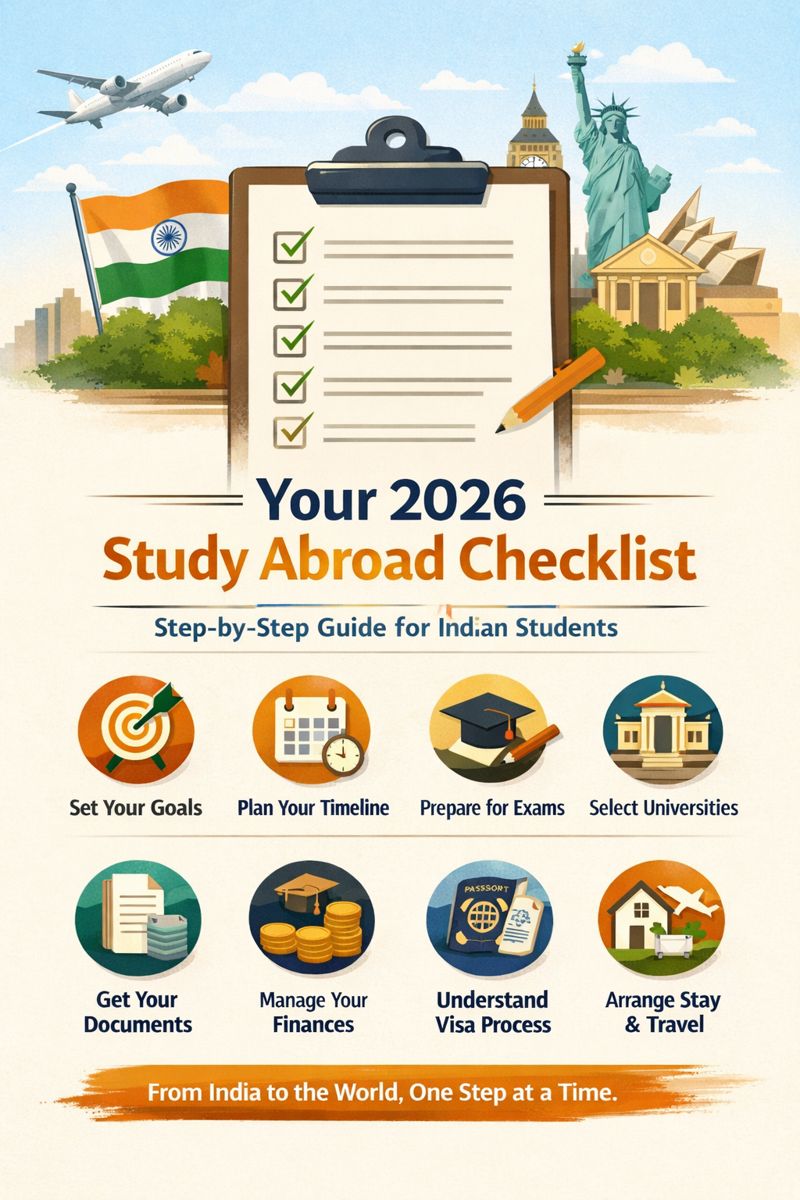
Studying abroad is not a single decision. It is a process that unfolds over months and sometimes years. Most problems Indian students face abroad do not start overseas. They start at home with poor planning, rushed decisions, or incomplete preparation.
That is why students and parents often search for a reliable 2026 study abroad checklist that explains exactly what to do, when to do it, and why it matters.
This blog is designed as the complete study abroad plan 2026. It walks Indian students through the full journey, step by step, from the moment you start thinking about studying abroad to the day you board the flight.
If you follow this checklist in order, you reduce stress, avoid common mistakes, and stay in control of your study abroad journey.
Step 1: Clarify your goal before choosing a country or university
The first mistake many students make is jumping straight to destinations or rankings. Before that, you must clarify your purpose.
Ask yourself:
- Why do I want to study abroad
- What career outcome am I aiming for
- Which industries interest me
- Do I want research, industry exposure, or both
This step is often skipped, but it determines every decision that follows. It is the foundation of the study abroad checklist for Indian students.
Step 2: Choose the right intake and timeline
Understanding timelines is critical. Most students underestimate how early they need to start.
A realistic timeline for study abroad preparation looks like this:
- 18 to 24 months before intake: Research and planning
- 15 to 18 months before intake: Test preparation
- 12 to 15 months before intake: University shortlisting
- 9 to 12 months before intake: Applications
- 6 to 9 months before intake: Offers and decisions
- 3 to 6 months before intake: Visa, finances, accommodation
If you are asking when to start preparing for study abroad, the safest answer is earlier than you think.
Step 3: Shortlist countries and universities strategically
Shortlisting is not about choosing the most popular options. It is about fit.
Consider:
- Course structure
- Teaching style
- Job outcomes
- Cost of living
- Post study work options
Indian students often rely on rankings alone. That leads to poor outcomes. Smart planning means comparing value, not brand.
This is a key part of the study abroad application checklist India students should follow carefully.
Step 4: Prepare for entrance exams early
Standardized tests are still required for many programs. Delaying preparation creates unnecessary pressure.
Common entrance exams include:
- IELTS or TOEFL for English proficiency
- GRE for technical and research programs
- GMAT for management programs
Start test preparation at least 12 to 15 months before intake. Early scores give you flexibility during applications.
Entrance exams are not just eligibility requirements. They influence scholarships and admissions quality.
Step 5: Prepare academic documents carefully
Documentation errors are one of the most common reasons applications get delayed or rejected.
Key documents needed for study abroad 2026 include:
- Academic transcripts
- Degree certificates or provisional letters
- Statement of Purpose
- Letters of Recommendation
- Resume or CV
Your SOP LOR transcripts must be accurate, well written, and aligned with the course you are applying for.
Avoid generic statements. Admissions committees look for clarity, not exaggeration.
Step 6: Apply with a clear strategy, not randomly
Applying to too many universities without a plan wastes time and money.
A smart application strategy includes:
- A mix of ambitious, realistic, and safe options
- Alignment between profile and course requirements
- Attention to deadlines
- Tailored SOPs for each university
This is where many study abroad decision mistakes happen. Quality matters more than quantity.
Step 7: Plan finances and scholarships early
Financial planning should begin alongside applications, not after offers arrive.
Key elements include:
- Tuition fees
- Living expenses
- Health insurance
- Visa costs
- Emergency funds
Explore:
- University scholarships
- Government funding
- Private scholarships
- Education loans
Strong planning around finances and scholarships reduces stress and protects families from last minute surprises.
Step 8: Understand visa requirements clearly
Visa rejection is one of the biggest fears for Indian students, but most issues arise from incomplete preparation.
Key visa requirements India students should focus on:
- Proof of funds
- Genuine student intent
- Accurate documentation
- Clear academic progression
Start visa preparation as soon as you accept an offer. Do not wait.
Understanding the visa process is a crucial part of the study abroad checklist timeline.
Step 9: Arrange accommodation and travel
Housing is often harder to secure than expected.
Options include:
- University accommodation
- Private student housing
- Shared apartments
Book temporary housing if permanent options are not confirmed. Never assume housing will be available after arrival.
Also plan:
- Flight tickets
- Airport pickup
- Initial living essentials
This step often determines how smooth your first month abroad feels.
Step 10: Prepare for life abroad, not just academics
The final step in the complete study abroad plan 2026 is personal readiness.
Prepare for:
- Cultural differences
- Independent living
- Budget management
- Healthcare access
- Emergency situations
Mental preparation matters as much as documentation. Students who prepare emotionally adjust faster and perform better.
What is the study abroad process for Indian students
In simple terms, the process includes:
- Goal clarity
- Timeline planning
- Test preparation
- University shortlisting
- Applications
- Financial planning
- Visa processing
- Pre departure readiness
Following this structure makes the process manageable and predictable.
Final checklist summary
The 2026 study abroad checklist works best when treated as a system, not a to do list. Each step builds on the previous one.
Students who follow a structured plan:
- Make better decisions
- Reduce stress
- Improve admission outcomes
- Avoid costly mistakes
This is why planning early and thoroughly is the real advantage.
Final thoughts
Studying abroad is one of the biggest investments an Indian family makes. Success is not about luck or shortcuts. It is about preparation, timing, and clarity.
This study abroad checklist for Indian students is not just a guide. It is a roadmap.
If you follow it step by step, you do not just apply abroad. You arrive prepared.








 Australia
  Canada
  France
  Germany
  India
India  Ireland
  UAE
UAE  United Kingdom
  United States