



For years, students and professionals have been told the same advice. Learn technical skills. Get certified. Master tools. That advice is not wrong, but in 2026, it is incomplete.
Employers today are not choosing candidates based on skills alone. They are choosing based on how those skills are applied in real situations. This is why the conversation around hard vs soft skills 2026 has become central to hiring decisions across industries.
As automation, AI tools, and global teams become the norm, companies are rethinking what makes someone truly valuable at work. This blog breaks down the most valued employer skills 2026, explains the real difference between hard skills and soft skills, and clarifies which skills actually get you hired.
Understanding the difference between hard skills and soft skills
Before discussing demand, it is important to understand what employers mean by these terms.
Hard skills are measurable, teachable abilities. These include technical skills like coding, data analysis, financial modeling, design tools, or laboratory techniques.
Soft skills are behavioral and interpersonal abilities. These include communication skills, teamwork, adaptability, leadership, and problem solving.
The difference between hard skills and soft skills is not about importance. It is about function. Hard skills help you do the job. Soft skills determine how well you do it with others, under pressure, and over time.
In 2026, employers are not choosing one over the other. They are choosing candidates who combine both.
Why employers are rebalancing skill priorities in 2026
Technology has changed the workplace faster than hiring criteria have evolved. Many technical tasks that once required specialists can now be automated or assisted by AI tools.
This has shifted the focus from pure execution to judgment, collaboration, and adaptability. That shift defines the future workforce skills 2026.
Employers now ask:
- Can this person learn new tools quickly
- Can they communicate clearly across teams
- Can they solve problems that do not have clear answers
- Can they work with AI rather than be replaced by it
This is why skills that get you hired in 2026 look different from skills that mattered five years ago.
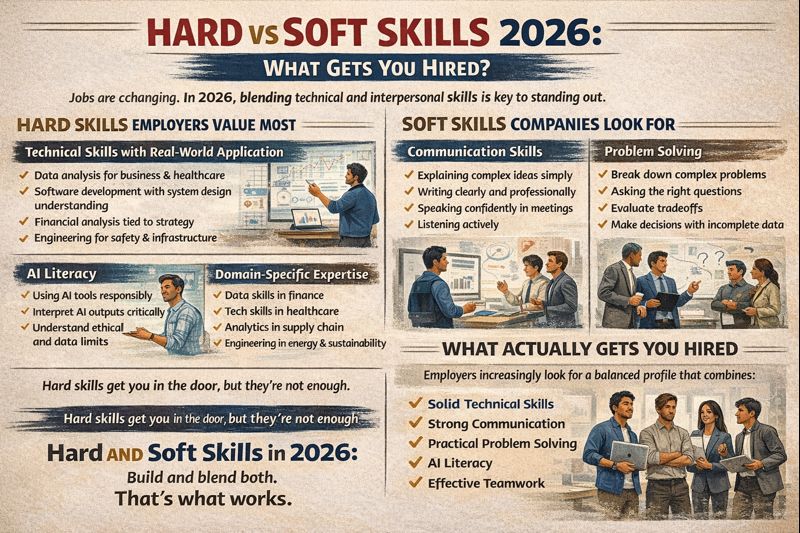
Hard skills employers value most in 2026
Hard skills still matter. They are often the first filter in hiring. But employers are selective about which ones truly add value.
1. Technical skills with real world application
Generic technical knowledge is no longer enough. Employers want applied technical skills tied to real outcomes.
Examples include:
- Data analysis applied to business or healthcare
- Software development with system design understanding
- Financial analysis tied to strategy and decision making
- Engineering skills linked to safety, systems, or infrastructure
These are the hard skills employers value most because they go beyond theory.
2. AI literacy
AI literacy is not about becoming an AI engineer. It is about understanding how AI tools work, where they help, and where they fail.
In 2026, employers expect professionals to:
- Use AI tools responsibly
- Interpret AI generated outputs critically
- Understand ethical and data limitations
- Integrate AI into workflows
AI literacy has become a core technical skill across industries.
3. Domain specific expertise
Hard skills are strongest when combined with domain knowledge. For example:
- Data skills in finance
- Technology skills in healthcare
- Analytics in supply chain
- Engineering skills in energy or sustainability
This combination increases job security and relevance, making these some of the top skills employers want in 2026.
Soft skills companies look for in 2026
If hard skills get you shortlisted, soft skills determine whether you are hired and promoted.
1. Communication skills
Clear communication remains one of the most important soft skills employers value.
This includes:
- Explaining complex ideas simply
- Writing clearly and professionally
- Speaking confidently in meetings
- Listening actively
In global teams, communication skills directly affect productivity and trust.
2. Problem solving
Problem solving is not about having the right answer. It is about approaching uncertainty logically.
Employers value candidates who:
- Break down complex problems
- Ask the right questions
- Evaluate tradeoffs
- Make decisions with incomplete data
Problem solving is one of the soft skills examples employers value across every industry.
3. Teamwork
Modern workplaces depend on collaboration. Very few roles are truly independent.
Strong teamwork involves:
- Respecting different perspectives
- Managing conflict professionally
- Contributing consistently
- Supporting shared goals
Teamwork is often what separates high performers from average ones.
4. Adaptability
In 2026, roles evolve constantly. Tools change. Teams restructure. Priorities shift.
Employers look for people who:
- Learn quickly
- Adjust without resistance
- Stay calm during change
- Take initiative in uncertainty
Adaptability is a core future workforce skill 2026 that cannot be automated.
Hard vs soft skills 2026: What actually matters more
The honest answer is neither alone.
Employers increasingly say:
- Hard skills get you in the door
- Soft skills determine how far you go
Candidates with strong technical skills but weak communication often struggle. Candidates with strong soft skills but weak technical foundations are not hired.
The most successful professionals are those who combine:
- Solid technical skills
- Strong communication skills
- Practical problem solving
- AI literacy
- Effective teamwork
This balance defines the most valued employer skills 2026.
What skills will be in demand in 2026
Across industries, the skills most in demand include:
- Applied technical skills
- AI literacy
- Communication skills
- Problem solving
- Teamwork
- Adaptability
These are not trends. They reflect how work itself is changing.
When people ask what skills will be in demand in 2026, the answer is not a single tool or certification. It is a skill set that blends technical ability with human judgment.
How to build the right skill mix for 2026
Students and professionals should stop thinking in terms of hard skills versus soft skills. The goal is integration.
Practical steps
- Choose courses that combine theory with projects
- Practice explaining technical work clearly
- Work in teams whenever possible
- Learn how AI tools apply to your field
- Seek feedback on communication and collaboration
This approach builds skills that get you hired in 2026, not just skills that look good on a resume.
Final perspective
In 2026, employers are not hiring resumes. They are hiring capability.
Hard skills show what you know. Soft skills show how you think, communicate, and adapt. Together, they define your value in the workplace.
Understanding hard vs soft skills 2026 is not about choosing sides. It is about building a profile that works in real jobs, real teams, and real challenges.
Those who focus on both will not just get hired. They will stay relevant.