A few weeks ago, someone pinged me on LinkedIn. She was one of the students I’d worked with back in 2022. She’s now at a solid company, earning well, doing very interesting work.
Her message was about her intention to do a master’s. When I asked “why”, her messages came very slowly and in confused language. Eventually I asked if it was about the aspiration of a much higher salary, which wouldn’t be realistically possible in India. She said “yes”.
I hear some version of this almost every week now.
The itch that won’t go away
If you’re 2–3 years into your career, you probably know this feeling. You’ve figured out the job. You know what your income progression will look like.
And somewhere in the back of your head, there’s this nagging thought — is this it?
Doing a Master’s abroad starts sounding like the answer. Not because you hate your job. But because you can feel the salary ceiling already.
You also want to work on more sophisticated problems, with smarter people, in rooms you don’t currently have access to.
But then you do the math. ₹40-50 lakhs. Quitting a paying job. Starting over as a student at 26 or 28. Your parents, who just got comfortable with you having a “settled” career, looking at you like you’ve lost your mind.
You keep thinking about it. You google “is an MS in the US worth it” at midnight. You read Reddit threads that contradict each other. And you stay stuck.
Well, it’s a problem.
The real problem is you’re figuring this out alone
When you were in college, you had a peer group. Everyone was applying to things, comparing notes, sharing tips. There was energy around the decision.
Now? Your colleagues don’t know you’re thinking about this. Your manager definitely cannot know. Your parents want you to stay put. Your friends from college are either too busy or too competitive to have an honest conversation with you about it.
And the internet seems pretty useless to help with this specific decision.
Every forum has someone saying “don’t bother unless it’s a top-10 school” and someone else saying “A master’s degree from the US changed my life.” Nobody knows your unique situation.
Nobody’s looking at your profile, your career trajectory, or your finances to give you a straight answer.
What you actually need is someone who’s made a big career by betting on themselves, and come out the other side. Someone who can look at where you are and say “yes, this makes sense” or “actually, you should think about it differently.”
That kind of access is almost impossible to find on your own.
That’s why the mentorship at MOTF matters more than the prizes
Let me tell you about Masters of the Future.
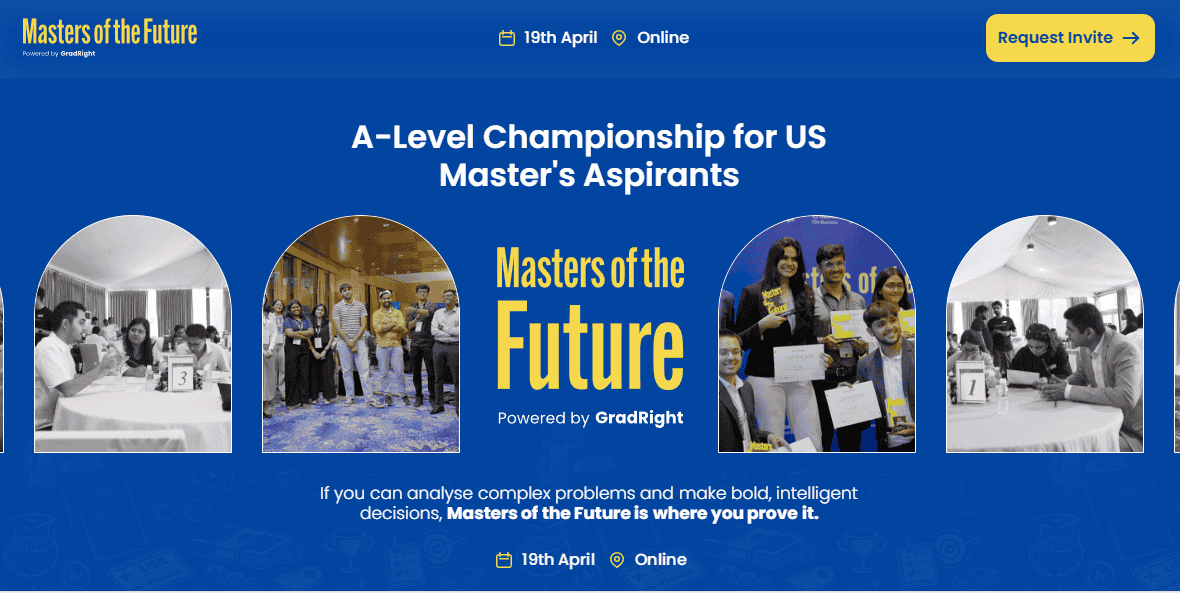
MOTF is a national competition organized by GradRight in partnership with US universities like WashU Olin, Rutgers Business School, Lehigh, and Tulane, for students and working professionals who are serious about a master’s abroad. You solve real business problems while university admissions teams and industry leaders evaluate you in real-time on how you think.
And for working professionals specifically, I think the most valuable part isn’t just the competition. It’s also who you get access to at the event.
The mentors at MOTF are not giving keynote speeches and leaving. They’re in the room. They’re evaluating your work. They’re pushing back on your ideas. And they’re available for real conversations.
I’m talking about people like Sarbvir Singh, CEO of PolicyBazaar. He’s someone who’s made career transitions himself and understands what it means to bet on yourself when the safe option is right there.
Kapil Bharati, who co-founded Delhivery and built one of India’s biggest logistics companies. If you’re in tech or operations thinking about a business degree, this is exactly the person you want 30 minutes with.
Bipin Preet Singh, who built MobiKwik from scratch, is the right man to talk to, for anyone in fintech or product thinking.
Tej Kapoor from IvyCap Ventures, who evaluates people and ideas for a living and can tell you honestly whether a master’s will actually accelerate your career.
These are people who can help you answer the one question nobody else around you can: is this the right move for me, right now?
For a working professional who’s been going back and forth, unclear for months, alone, that kind of clarity is worth more than any scholarship.
If you want to be in that conversation: Register for MOTF 2026
The Professional Track- and how it works
MOTF has a separate track specifically for working professionals. You’re not competing against final-year students with capstone projects. You’re being evaluated alongside other professionals with real work experience.
Here’s what the process looks like:
Step 1 — The Builder’s Proof. You submit a real-world project with measurable impact. Something you actually built, shipped, or led at work. Not a college assignment. Your work speaks for itself.
Step 2 — Vision Interview. If shortlisted, you do a leadership and global readiness interview. They’re checking whether you have clarity on why you want a master’s, what you plan to do with it, and whether you’re ready.
Step 3 — National Selection. Top performers advance directly to the finale, which is an online event on April 19, 2026.
The important part: you don’t have to quit your job to do any of this. The first round is a submission you do on your own time. The interview is scheduled around your availability. The finale is online. This is designed for people who are working.
What you actually walk away with
Even if you don’t win, you walk away with clarity. Two days of pressure-testing your own career thinking with mentors and peers who actually understand your situation. That alone is worth it.
But the tangible stuff is real too.
A ₹5 Crore scholarship pool from partner universities.
Over ₹4 lakhs in prizes.
Sponsored one-way flight tickets to the US for winners.
Direct admission consideration from WashU, Rutgers, Lehigh, Tulane, University of San Diego, and University of South Dakota.
Priority education loans up to ₹1 Crore.
And something people don’t talk about enough, which is a peer network. Being in a room with 29 other professionals at the same crossroads as you. People who get it. People you’ll stay in touch with long after MOTF is over.
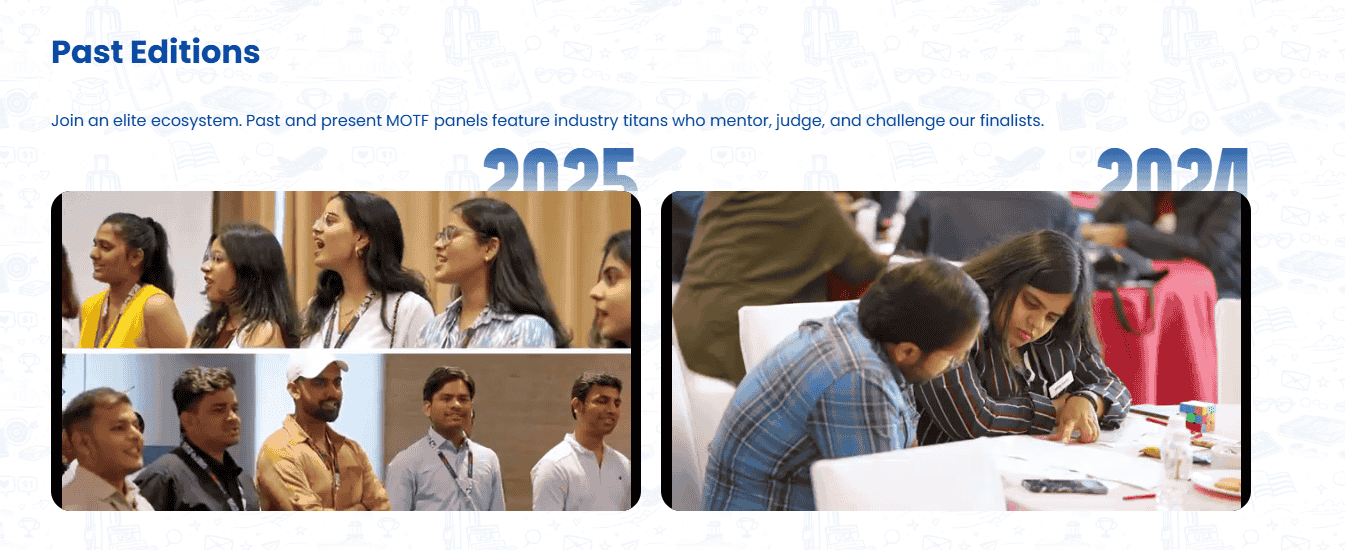
See what this looked like last time:
You don’t have to quit your job to find out
MOTF doesn’t ask you to leave anything behind. It asks you to show up and see what’s possible. It’s free to apply. The first round takes less time than most work presentations you’ve already given this quarter.

And if you’re figuring out the bigger picture like which universities, which loans, what scholarships, download the GradRight app from Google Play Store or Apple App Store. It’s an AI-powered study abroad and education finance platform that helps you discover the right programs, universities, scholarships, loans, and everything else you need, all in one place.
The best time to figure this out was a year ago. The second best time is right now, and it doesn’t cost you anything to start.