





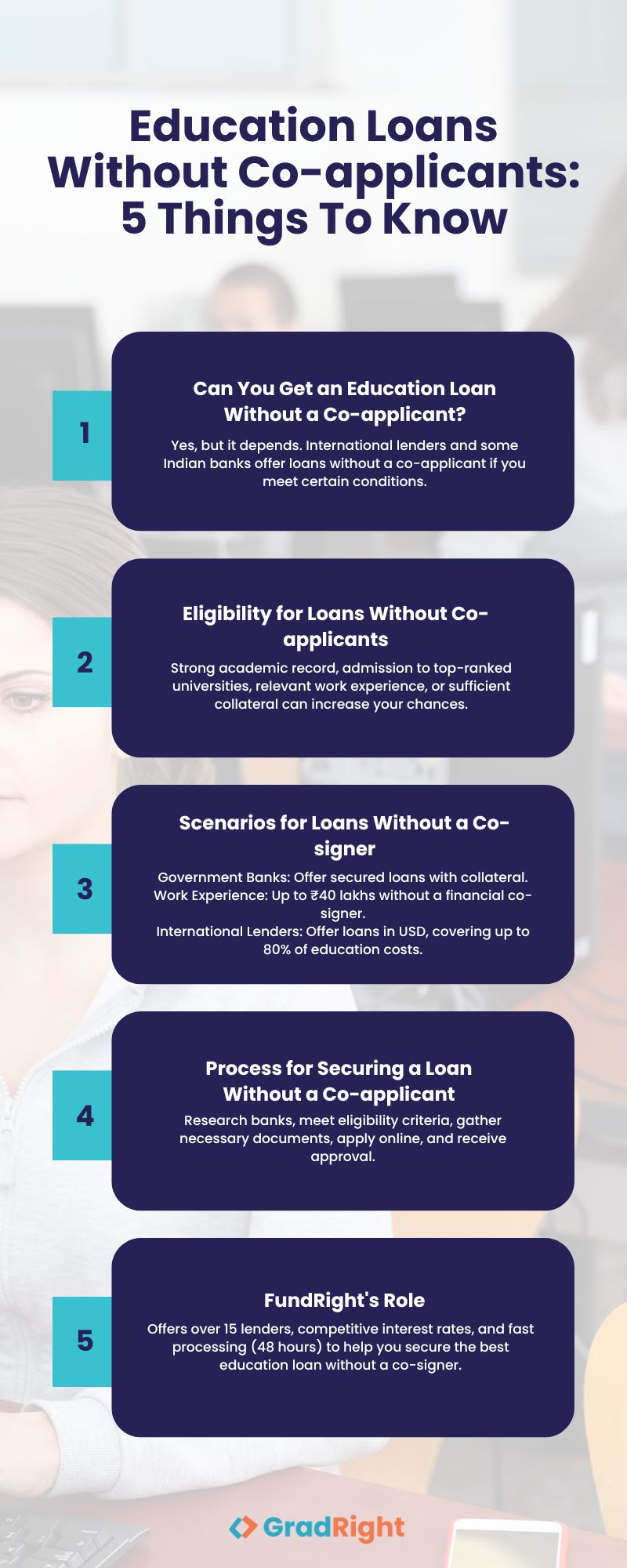
Quick Answer: Yes, you can get an education loan without a co-applicant in India – but it depends on which type you need. International lenders (Prodigy Finance, MPower) offer loans without any co-applicant for eligible universities. Indian banks can give loans without a financial co-applicant (earning relative) but usually still need a primary co-applicant (parent/spouse as contact). 3 pathways: (1) Government bank with collateral, (2) 3+ years work experience with Rs 35K+ monthly salary at top-300 university, (3) International lenders for eligible universities.
The US is still one of the most popular study abroad destinations for Indian students. In 2024-25, the Indian student population in the US stood at 363,019 (Open Doors 2025). Despite its popularity, the US continues to be one of the more expensive study destinations. You can expect to pay up to $55,000 a year in tuition fees, plus around $40,000 a year in food, accommodation, and living expenses.
Education loans can help cover the majority of the cost. This guide explains whether it is possible to get a student loan without a cosigner, the difference between a financial and primary co-applicant, three specific pathways to a no-co-applicant loan, and what documents you need.
Note: Different banks use different terms. Some will call this co-applicant. Others will call it co-borrower or joint borrower. The idea is the same. When students search for no cosigner, they often mean no earning co-applicant – not no second name on the loan papers. This distinction matters throughout this guide.
“Only a tenth are being funded by these NBFCs… a large portion of overseas education is being funded through alternative means.” — Ajit Velonie, Senior Director, CRISIL Ratings
Can You Get an Education Loan Without a Co-Applicant?
The short answer: it depends. International lenders offer education loans without any co-applicant. However, these lenders keep a list of selected universities for which they give out the loans. If your university is not on the list, you will not be eligible.
With Indian banks, the scenario is different. While banks like SBI and Bank of Baroda may offer education loans without a financial co-applicant if you provide sufficient collateral, a primary co-applicant is usually still required. Several public banks updated their policies in 2024, allowing loans without co-applicants for students with strong academic backgrounds or significant work experience.
Additionally, several universities – such as Harvard, NYU, ESSEC, and LSE – have partnerships with lenders that offer favourable terms to students without needing a co-signer.
Therefore, when you hear the phrase education loan without a co-applicant, know that this usually means without a financial co-applicant, not without a primary co-applicant. We will discuss the three scenarios where you can get a loan without any co-applicant later in this article.
Also Read: Non-Collateral Education Loan for Study Abroad: How To Apply?
What is the Difference Between a Financial Co-Applicant and a Primary Co-Applicant?
|
Aspect |
Financial Co-Applicant |
Primary Co-Applicant |
|
Role |
Supports the financial eligibility of the loan application |
Primarily serves as a contact and guarantor with limited impact on financial eligibility |
|
Who Can Be Assigned |
Siblings, uncles, aunts, cousins |
Parents, spouse, or immediate family members |
|
Income Requirement |
Must have a stable income |
No income requirement; can be a retired person |
|
Impact on Loan Approval |
Significant impact if the primary applicant has weak financials |
Limited impact; serves more of a procedural role |
|
Example |
A sibling with a steady job acting as financial co-applicant |
A retired parent acting as primary co-applicant |
Financial Co-Applicant – Details
A financial co-applicant is a person who is related by blood to the loan applicant. The loan applicant needs a financial co-applicant when they do not have a primary co-applicant with a permanent income. Loan applicants can put their siblings, first cousins, maternal uncle or aunt, and paternal uncle or aunt as financial co-applicants.
Primary Co-Applicant – Details
A primary co-applicant is a person who co-signs the education loan agreement with the loan applicant. The co-applicant’s financial profile does not affect their eligibility. Applicants can name their parents or any immediate family member – even when they do not have a stable income or when they are retired pensioners – as primary co-applicants.
In summary: a financial co-applicant is someone with a strong financial profile who backs your loan application. A primary co-applicant’s role is more administrative, ensuring that there is a responsible contact person for the loan.
Also Read: Education Loan Eligibility Criteria Guide for Indian Students
3 Scenarios Where You Can Get a Student Loan Without a Co-Signer
Scenario 1: Taking an Education Loan from a Government Bank (with Collateral)
Government banks take collateral to secure education loans. Thus, the banks do not care much about having a co-applicant or the financial profile of the co-applicant. Government banks also offer a payment-free moratorium period. During the moratorium period, you usually do not have to start EMI payments – but the interest continues to accrue and can be added to the outstanding amount.
This scenario works if you have collateral (property, fixed deposits) of sufficient value to secure the loan amount you need. Without collateral, and without a financial co-applicant, you need one of the next two scenarios.
Scenario 2: Having Work Experience (Up to Rs 40 Lakhs Without Collateral)
If you qualify for this scenario, you can receive up to Rs 40 lakhs in student loans without a financial co-signer or collateral. The interest rate for these loans ranges between 10.5% to 11%.
|
Eligibility Criterion |
Requirement |
|
Work experience |
Minimum 3 years of relevant work experience |
|
Last drawn salary |
Minimum Rs 35,000 per month (Rs 35K/month) |
|
University selection |
Top 300 universities worldwide (as per lender list) |
|
Course selection |
MS or MBA program only |
|
Primary co-applicant |
Still required for contact purposes – but financial profile not checked |
|
Primary co-applicant relationship |
Parents, siblings, spouse, or in-laws only |
Scenario 3: Going to International Lenders
International lenders offer student loans without a co-signer. The lenders offer student loans in USD and can cover up to 80% of the total cost of education. Interest rates range between 9% to 10.5%.
Important: International lenders only offer loans when you qualify to study at one of the universities they have tied up with. If your university is not on their list, you will not be eligible.
|
Lender |
Key Features |
Best For |
|
Prodigy Finance |
No co-applicant, no collateral; USD loans at 9-10.5%; 750+ partner universities globally; pay after graduation |
Top global university students; MBA especially strong |
|
MPower Financing |
No co-applicant, no collateral; USD loans; US and Canada universities; focus on future earnings potential |
US and Canada university students with strong career prospects |
|
Leap Finance |
No co-applicant; INR loans; focus on Indian students at select US universities; growing university list |
Indian students who want to avoid currency risk with INR repayment |
|
Auxilo |
No collateral up to specified limits; India-based NBFC; partner universities list applies |
Students at eligible universities wanting India-based lender without collateral |
Currency risk warning: International loans are typically in USD. The interest rate stays in USD. If the rupee weakens, you need more INR to repay the same dollars. Run a repayment stress check for exchange-rate swings before signing. Also check whether Section 80E tax benefits apply – these are available only when the education loan is taken from a financial institution or approved charitable institution as defined under Indian law.
Also Read: Prodigy Finance vs Leap Finance: Which Is Better?
Eligibility for Education Loan Without Co-Applicant in India 2026
|
Eligibility Factor |
Details |
|
Strong Academic Record |
High GPA, strong GRE/GMAT scores considered by international lenders. Strong academics can offset lack of co-applicant. |
|
University and Course Selection |
Admission to a top-ranked university, especially those partnered with specific lenders. MS, MBA, or STEM degrees are more likely to be considered. |
|
Work Experience |
3+ years of relevant work experience with Rs 35K+/month salary opens the non-collateral, no financial co-applicant option (Scenario 2). |
|
Collateral Availability |
Property, fixed deposits, or other assets of sufficient value cover the loan for public banks (Scenario 1). |
|
University Recognition by Lender |
Each lender has an approved university list. Admission to these institutions is mandatory for international lender loans (Scenario 3). |
|
Total Cost Sheet |
Lenders want a clear estimate of tuition + living costs. Clean cost sheet speeds up sanction. Most lenders size the loan based on this. |
|
Gap Plan |
Show how your own contribution + loan covers the full cost. Lenders look for this clarity even without a co-applicant. |
The easiest way to gauge eligibility is to think like a lender. Even without a co-applicant, the bank needs confidence in two things: Can the course and university justify the loan size? Can you realistically repay once you graduate? These two questions drive every eligibility decision.
GradRight helps you find universities where your loan eligibility is strongest – programs that match your academic profile, budget, and are on lender approved lists. Shortlist programs where funding is achievable, not just where admission is possible. Find Fundable Programs on GradRight
Benefits of Getting an Education Loan Without a Co-Applicant
|
Benefit |
Detail |
|
Financial independence |
Gives you financial independence, allowing you to manage your education expenses without depending on family members with income. |
|
Access when family support is limited |
If you do not have financially strong family members or guardians, getting a loan without a co-applicant opens up opportunities that might otherwise be out of reach. |
|
Faster processing |
Lenders offering non-co-signed loans often have streamlined processes, reducing approval time since there is no need to evaluate another person’s financial profile. |
|
Simpler paperwork |
Without needing to involve a financial co-applicant, the paperwork is simpler and the application process more straightforward. |
|
Focus on academic merit |
Lenders focus more on your academic achievements, course selection, and university ranking – giving strong students a much better chance of approval. |
Cons of Taking an Education Loan from International Lenders
- Section 80E tax benefits are available only when the education loan is taken from a financial institution or approved charitable institution as defined under Indian law. Check this before you sign – do not assume either way.
- Currency fluctuation risk: your EMI is typically in USD. The interest rate stays in USD. If the rupee weakens, you need more INR to repay the same dollars. Run a repayment stress check for exchange-rate swings.
- University list restrictions: not all universities are eligible. If your target university is not on the lender’s approved list, you will not qualify regardless of your profile.
- Higher interest rates: international lenders typically charge 9-10.5% in USD vs Indian public bank rates of 8.5-10.5% in INR. The USD rate may sound similar or lower, but currency risk makes the true cost higher.
- Disbursement terms: for US universities, disbursement is often semester-wise. Confirm how the lender releases funds and keep your payment schedule ready.
Also Read: Best Education Loan Providers in India 2026: Banks, NBFCs and Comparison
Documents Required for Education Loans Without a Cosigner
For Government Banks (with Collateral)
|
Document |
Details |
|
University enrollment letter |
Official letter confirming your admission and course details |
|
Collateral proof |
Property papers, fixed deposit certificates, or other forms of collateral (originals and photocopies) |
|
Academic documents |
English copies of all transcripts, certificates, and mark sheets |
|
Identity proof |
Original Passport, Aadhaar card, or PAN card |
|
Income proof |
Salary slips, Form 16, or bank statements if self-financing |
|
Cost sheet |
Fee structure, housing estimate, and insurance estimate from the university |
|
Loan application form |
Completed and signed application form |
For Indian Private Banks and NBFCs
|
Document |
Details |
|
University admission letter |
Official letter with course details and fee structure |
|
Employment documents |
Past employment proof, especially if using work experience to qualify without cosigner |
|
Income proof |
Recent salary slips (last 3 months) or bank statements if self-employed |
|
KYC documents |
Two KYC documents: identity + address proof (Aadhaar, voter ID, driving license, passport copy) |
|
Collateral documents |
If applicable – property or asset documents to pledge as collateral |
|
Cost sheet |
Full tuition + living expense estimate. Keep this ready – many lenders ask for it early. |
For International Lenders
|
Document |
Details |
|
University admission offer letter |
Must be from a partner university – check each lender’s approved list before applying |
|
Valid passport |
Compulsory for identity verification |
|
Academic documents |
Mark sheets and certificates from previous education; official English translation if not in English |
|
Work experience/scholarship proof |
If applying based on work experience or scholarship, include relevant letters and documentation |
|
Cost sheet |
Tuition, housing, insurance, and living cost estimate – lenders use this to size the loan correctly |
Process for Getting an Education Loan Without a Co-Applicant in India
|
Step |
Action |
|
Step 1: Research lenders |
Research Indian banks and financial institutions offering loans without a financial co-applicant. Public sector banks (SBI, Bank of Baroda) are good for collateral-backed loans. NBFCs (Avanse, Credila, Auxilo) and international lenders (Prodigy Finance, MPower) for no-collateral options. |
|
Step 2: Confirm eligibility |
Ensure you meet the bank’s eligibility criteria – admission letter, academic record, work experience (if applicable), collateral (if needed). Clarify whether no cosigner means no earning co-applicant or no second borrower for each lender. |
|
Step 3: Gather documents |
Prepare admission letter, academic records, identity proof, collateral documents (if needed), income proof, and a clean cost sheet showing tuition + living expenses. |
|
Step 4: Apply (online or in-person) |
Most banks now offer an online application process. Fill out the application form, upload documents, and submit. Visit the bank branch if you prefer a physical application. |
|
Step 5: Verification |
The bank verifies your documents, checks eligibility, and processes your application. This may include a representative visiting your collateral property (if applicable) for verification. |
|
Step 6: Sanction and disbursement |
Once approved, receive a loan sanction letter detailing the loan amount, interest rate, and repayment terms. Funds are disbursed directly to your educational institution – often semester-wise for US universities. |
Practical tip: Find out if the lender means no cosigner as in no earning co-applicant, or no second borrower? In India, it is usually the first. That clarity saves a lot of back-and-forth. Sanction is not the finish line – disbursement schedule matters too.
GradRight: Over 30 lenders including public and private sector banks, NBFCs, and international lenders compete to offer you customised education loans. 48-hour processing time. Students using GradRight App get up to 40% better loan rates. Apply on GradRight
Also Read: Education Loan Interest Rates Explained
Related Guides
Non-Collateral Education Loan for Study Abroad: How To Apply?
Best Education Loan Providers in India 2026: Banks, NBFCs and Comparison
Prodigy Finance vs Leap Finance: Which Is Better?
Education Loan Interest Rates Explained
Education Loan Eligibility Criteria Guide for Indian Students
Study Loan for Canada in 2026
GradRight FundRight – Education Loan Platform




 Australia
  Canada
  France
  Germany
  India
India  Ireland
  UAE
UAE  United Kingdom
  United States