





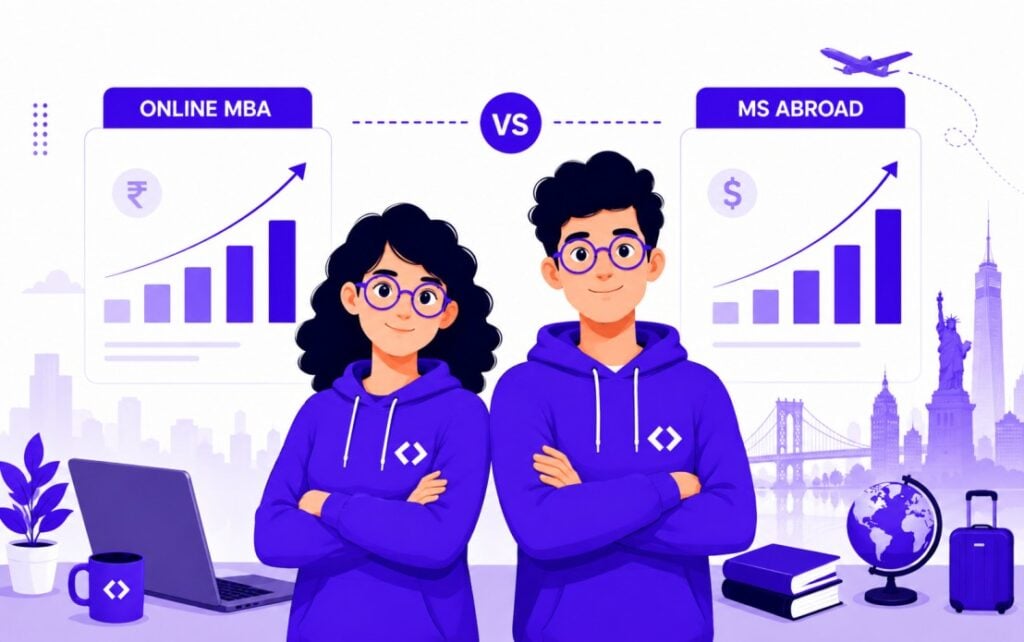
A few years ago, this question had a fairly clear answer. On-campus Master’s programmes, especially from foreign universities, carried undeniable advantages in employer recognition, post-study work visa access, and network building. Online degrees, meanwhile, were viewed with scepticism by many recruiters and offered no immigration pathway whatsoever.
In 2026, that gap has narrowed considerably, but it has not closed. The right answer still depends on who you are, what you are trying to achieve, and which specific programme you are comparing. For working professionals in India looking to upskill in data science or AI without taking a career break, the calculation looks very different from that of a fresh graduate targeting a US tech job with STEM-OPT eligibility.
This blog breaks down the ROI comparison honestly across five dimensions: cost, employer recognition, career outcomes, post-study work rights, and the specific case of online Master’s in data science and AI for Indian professionals.
Why this comparison matters more in 2026 than it did before
Online Master’s degree enrolment in India grew by over 179 percent between 2021 and 2025, reaching over 72,000 students in UGC-approved programmes alone. Moreover, the number of UGC-approved universities offering online degrees has grown from 68 to over 191 in that same period. Consequently, Indian students now have genuine options that did not exist five years ago, and the employer landscape has shifted to reflect this.
At the same time, on-campus foreign degrees have become more expensive and, in some cases, harder to monetise. Unsecured loan interest rates sit at 12 to 14 percent. The US H-1B lottery runs at roughly 28 percent odds. Canada’s job market for tech graduates has cooled since 2024. Therefore, the question of whether a ₹60 to ₹90 lakh on-campus foreign degree outperforms a ₹2 to ₹8 lakh Indian online Master’s deserves a genuinely rigorous answer, not just a default assumption.
Dimension 1: Cost and total financial investment
This is where the gap between online and on-campus is, frankly, enormous. There is no meaningful way to soften it.
| Programme Type | Typical Total Cost (Tuition + Living) | Duration | Income Lost During Study |
| On-campus MS abroad (USA) | ₹70 lakh to ₹1.1 crore | 1.5 to 2 years | Full salary (₹8 to ₹20 LPA opportunity cost) |
| On-campus MS abroad (UK, 1 year) | ₹40 to ₹60 lakh | 1 year | Full salary (₹8 to ₹20 LPA opportunity cost) |
| On-campus MS abroad (Germany) | ₹15 to ₹22 lakh | 2 years | Full salary |
| Online MS (Indian UGC-approved, top institute) | ₹1.5 to ₹6 lakh | 1.5 to 2 years | Zero (study while working) |
| Online MS (foreign university, e.g. Georgia Tech OMSCS) | ₹6 to ₹9 lakh | 2 to 3 years | Zero (study while working) |
| Hybrid/Online MS from foreign branch campus in India | ₹10 to ₹20 lakh | 1.5 to 2 years | Partial (depends on structure) |
The opportunity cost row matters. A student earning ₹12 LPA who takes two years off for a US Master’s forgoes ₹24 lakh in salary, in addition to the ₹70 to ₹90 lakh in direct costs. Total financial exposure is therefore ₹94 lakh to ₹1.14 crore before a single EMI is repaid.
By contrast, a working professional completing an online Master’s in data science from IIT Madras or BITS Pilani Digital continues earning their full salary throughout the programme. In addition, they do not take on any education debt. The break-even comparison, consequently, starts from very different points.
However, cost alone does not determine ROI. The question is what each investment returns in terms of salary and career trajectory.
Get tailored loan options at the lowest interest rates and compare offers from 15+ financial institutions on GradRight.
Dimension 2: Employer recognition in 2026
This is the dimension where honest nuance matters most, because the answer is different for Indian employers, global employers, and specific sectors.
Indian Employers: Online Degrees Gaining Ground
In most private-sector roles, a recognised online MBA degree in India carries similar weight as its on-campus counterpart when awarded by approved institutions. Employer acceptance has improved significantly due to regulatory clarity from UGC and the demonstrated quality of graduates from accredited institutions.
Furthermore, 68 percent of recruiters now view online degrees equally, up from 45 percent a few years ago. Tech companies like Google have stopped checking degrees completely, and PSUs now accept UGC-approved ones fully.
That said, this shift is concentrated in specific sectors: technology, data, business analytics, and operations. For roles in consulting, investment banking, and senior management, the on-campus degree still carries a structural advantage because of the screening function it serves in competitive hiring processes.
International Employers: Accreditation is What Matters
For students targeting roles abroad, the delivery mode matters less than the accreditation and the university brand. About 70 percent of hiring managers regard online computer science degrees as equally valid if other qualifications align. Accreditation matters most: employers focus primarily on whether a degree comes from an accredited programme rather than its delivery mode.
Therefore, an online MS from Georgia Tech (ranked top 10 globally for CS) carries enormous employer weight. An online MS from a mid-tier private Indian university with no international recognition carries very little weight with foreign employers. The question is not online versus on-campus in the abstract. It is which institution and which accreditation is behind the degree.
| Programme | Employer Recognition in India | Employer Recognition Abroad | Post-Study Work Rights |
| On-campus MS, top-50 foreign university | High | High | Full (visa-linked) |
| On-campus MS, mid-ranked foreign university | Medium-High | Medium | Full (visa-linked) |
| Online MS, IIT Madras / BITS Pilani Digital (India) | High | Low to Medium | None |
| Online MS, Georgia Tech OMSCS (USA) | Medium-High | High | None |
| Online MS, private Indian university (UGC-approved) | Medium | Low | None |
To find programs suited to your profile, head to GradRight and make a personalized shortlist with admit chances
Dimension 3: Post-study work rights and immigration pathways
This is the clearest win for on-campus foreign degrees, and it is non-negotiable. No online Master’s programme, whether delivered from India or from a foreign university, qualifies for a post-study work visa.
In the US, OPT and STEM-OPT require F-1 student visa status, which means you must be physically enrolled on campus in the USA. In the UK, the Graduate Route requires a valid Student visa and physical completion of a course at a Home Office-approved institution in the UK. Canada’s PGWP requires completing a full-time programme at a Designated Learning Institution in Canada. Germany’s 18-month job seeker permit requires a degree from a German university earned in Germany.
Consequently, for Indian students whose primary goal is to work and potentially settle abroad after graduation, an online degree provides no immigration pathway. This is the single most important differentiator and the one where on-campus foreign degrees have an absolute advantage that cost savings cannot bridge.
However, for students who plan to stay in India or who are already employed and only want a salary or promotion boost, post-study work rights are irrelevant to their decision.
Dimension 4: Online Master’s in data science and AI for working professionals in India
This is where the online option is genuinely compelling, and the data supports it. India is expected to need approximately one million data professionals annually, with NASSCOM projecting seven million data-related roles by 2030. By 2025, entry-level data scientists pulled in up to ₹11.8 lakhs, averaging ₹13 to ₹15 lakhs, with mid-level professionals eyeing ₹22 lakhs by 2030.
For working professionals in India, the online Master’s in data science and the online Master’s in AI now represent genuinely well-designed upskilling routes, particularly from the following institutions.
Top Online Data Science and AI Programmes for Indian Professionals
| Programme | Institution | Cost | Duration | UGC/AICTE Status |
| MSc in Data Science and AI | IIT Madras (via Coursera) | ₹2 to ₹4 lakh | 2 years | AICTE approved, Institute of Eminence |
| MSc in Data Science | BITS Pilani Digital | ₹3.5 to ₹5 lakh | 2 years | UGC approved |
| Online MS in Computer Science (OMSCS) | Georgia Tech (USA) | ₹6 to ₹9 lakh | 2 to 3 years | ABET accredited |
| MSc in AI and Machine Learning | Liverpool John Moores University (via online) | ₹8 to ₹12 lakh | 2 years | UK-accredited |
| Executive Data Science Programme | IIM Calcutta / Kotak School | ₹4 to ₹7 lakh | 1 to 1.5 years | AICTE approved |
The IIT Madras programme deserves special mention. IIT Madras launched its online interdisciplinary programmes, paving the way for other universities to embody the vision of NEP 2020. Online enrolments in such programmes shot up over 50 percent from 2021 to 2025, with working professionals now averaging 28 years old.
For a working professional earning ₹10 to ₹15 LPA, completing an online data science Master’s from IIT Madras at ₹3 lakh while continuing to earn full salary, and using the degree to negotiate a move to a data-focused role at ₹18 to ₹22 LPA, produces a break-even in under six months. That ROI is structurally better than almost any on-campus degree, foreign or domestic.
Dimension 5: UGC approved online degree courses in India — what qualifies and what doesn’t
Not all online Master’s degrees in India are equal, and this is one of the most consequential things to check before enrolling. The UGC-DEB (Distance Education Bureau) framework specifies exactly which universities can offer fully online degrees. As of 2026, over 191 universities have some form of UGC-DEB recognition, though the quality and scope of programmes varies significantly.
A UGC-approved online degree is one that meets the academic and technical standards set by the University Grants Commission. These programmes carry the same curriculum, credit, and evaluation system as regular on-campus programmes. Moreover, they are fully equivalent for employment in the private sector, government roles (where applicable), and further academic study.
What to check before enrolling in any online Master’s in India:
| Verification Step | How to Check | Why It Matters |
| UGC-DEB recognition | Visit ugcdeb.ac.in and search the institution | Degrees from unrecognised institutions are not valid for government employment or further study |
| NAAC accreditation grade | Visit naac.gov.in | NAAC A or A+ signals curriculum quality and employer confidence |
| NIRF ranking | Visit nirfindia.org | Gives a standardised quality benchmark for comparison |
| Programme-specific approval | Check whether your specific course (not just the university) is approved | Some universities are approved for MBA but not for MCA or MSc |
| Employer acceptance | Search LinkedIn for graduates of the programme and see where they work | Most reliable signal of actual career outcomes |
The UGC has clarified that students can transition between online and regular modes of study, provided both institutions have UGC-DEB recognition and agree on credit transfers. This gives online students a pathway to continue to on-campus or hybrid programmes if their circumstances change.
The direct comparison: who should choose what
| Student Profile | Better Option | Reasoning |
| Fresh graduate, targeting US/Canada/Germany job market | On-campus foreign degree | Post-study work visa is essential; no online pathway exists |
| Working professional, ₹8 to ₹15 LPA, wants to move into data science | Online MS (IIT Madras, BITS Pilani Digital) | ROI in under 1 year; no income lost; UGC recognised |
| Working professional, wants international brand on CV | Online MS from Georgia Tech or UK university | High employer recognition abroad; no visa benefit |
| Student targeting Indian GCC or MNC roles without immigration | Online MS from top Indian institution | Strong employer acceptance in tech sector; very low cost |
| Student targeting immigration with STEM background | On-campus MS (Germany or Ireland for best cost-ROI ratio) | Visa pathway is non-negotiable; Germany offers best cost |
| Mid-career professional wanting MBA equivalent for management roles | Online MBA (NMIMS, Manipal, Chandigarh University) | UGC approved; employer accepted; study while earning |
The bottom line
Online and on-campus Master’s are not competing for the same student in 2026. They serve genuinely different needs, and the ROI comparison only makes sense when you define what return you are actually looking for.
If your goal is to work and build a career abroad, an on-campus foreign degree is the only route. There is no online alternative to a post-study work visa. Therefore, for that goal, the financial comparison with an online degree is beside the point.
If your goal is to upskill in data science, AI, or business analytics while staying employed in India, an online Master’s from a UGC-approved institution delivers faster break-even than almost any foreign on-campus option. In addition, the opportunity cost difference, two years of forgone salary, is substantial enough to change the financial case completely.
Furthermore, the hybrid middle ground is emerging. Foreign branch campuses in India, such as Deakin University at GIFT City and the University of Southampton in Gurugram, and hybrid programmes where the first phase is online and the second is on-campus abroad, offer a third pathway that some students will find optimal. These cost 30 to 50 percent less than a full on-campus foreign programme and, in some cases, preserve partial post-study work visa eligibility depending on the structure.
GradRight helps Indian students compare education loan options across 15+ lenders for on-campus programmes and model their repayment timelines before committing. If you are deciding between online and on-campus and want to run your specific numbers, start with a free GradRight profile.







 Australia
  Canada
  France
  Germany
  India
India  Ireland
  UAE
UAE  United Kingdom
  United States