

I don’t recall anyone asking me, “Should I do a hackathon? Will it help my application?”
That’s not how most students think, which I feel is a big problem.
Every platform where you can speak to others who are on a similar journey is worth 100 hours of research on the Internet.
There are hundreds of competitions and hackathons in India right now.
Your LinkedIn feed might be full of them.
The problem is, even when you want to actively participate, you know it’s going to take a lot of time.
So, it’s important you choose well.
So the real question isn’t “which competitions are out there?”, but “which ones are worth your time?”
How To Choose the “Right” Competition to Participate In
Before you sign up for anything, ask yourself four things.
- Are university admissions teams involved in the competition?
If professors or admissions officers from universities you’re applying to are evaluating your work, that’s a direct impact. If it’s judged by random panelists, it’s a credential, but a weaker one. - Does it lead to something tangible?
Scholarships, admission consideration, a strong recommendation — all these matter for your application. A participation certificate doesn’t. - Does it test what university admissions teams care about?
They want to see how you think, communicate, solve problems, and collaborate. A speed-coding contest which tests algorithmic thinking, is useful for jobs, but might not be useful for a master’s application in analytics or finance. - Is it known outside India?
This matters. If you’re applying to a US university, a competition that’s globally recognized carries more weight than one that’s well-known only within Indian colleges.
Keep these four questions in mind. They’ll help you sort through everything below.
What’s Out There Right Now — An Honest Look
Coding Hackathons and Tech Competitions
- Smart India Hackathon (SIH) is the big government-run one. It’s great for problem-solving experience and looks good on a resume made for admissions in India. But US admissions teams don’t know what it is. It won’t hurt your application, but it won’t be the thing that gets you noticed either.
- Unstop Hackathons — there are tons of them, across every domain. They are generally good for building a portfolio and learning to work under pressure. Same limitation though; there’s no recognisability with universities abroad.
- ICPC is genuinely prestigious and globally recognized. If you’re applying for a CS program specifically, good performance in ICPC stands for something. But it’s pure competitive programming. It doesn’t demonstrate the broader thinking that most master’s programs look for.
- Microsoft Imagine Cup is global and well-known. It’s about building tech products, which is great, but it’s not tied to master’s admissions or scholarships.
Case Competitions and Social Entrepreneurship
- Hult Prize is a major competition recognised globally. It is held on campuses across India (IITs, IIMs, and others). It’s about building a social enterprise, and the winner gets $1 million in seed funding. Impressive, yes, but it’s focused on social entrepreneurship.
- Global Case Competition at Harvard (GCCH) — real business cases, judged by HBS professors, fully online. Very competitive. But no scholarships and no admission consideration attached to it.
- Corporate case competitions (L’Oréal Brandstorm, Unilever LIME, Mahindra War Room) — these are good resume lines and teach you real business thinking. But again, they don’t connect you to the universities you’re trying to get into.
So here’s the big gap.
None of these competitions align with what your final goal is- getting into a Master’s programme in the US.
But what if you could participate in a competition specifically designed for the purpose of helping you get in? A space that brings you directly in contact with the admissions team of your dream university, offers you scholarships if you win, and even sponsors your one-way flight ticket to the US?
MOTF — Masters of the Future by GradRight
I need to be upfront: I work at GradRight, so keep reading with that added context. But I’m including MOTF here because it does something genuinely different from every other competition listed above, and I think you, a someone looking to apply to colleges in the US, should know about it.
MOTF is a national championship organized by GradRight in partnership with US universities such as WashU Olin Business School, Rutgers Business School, Lehigh, Tulane, University of San Diego, and University of South Dakota.
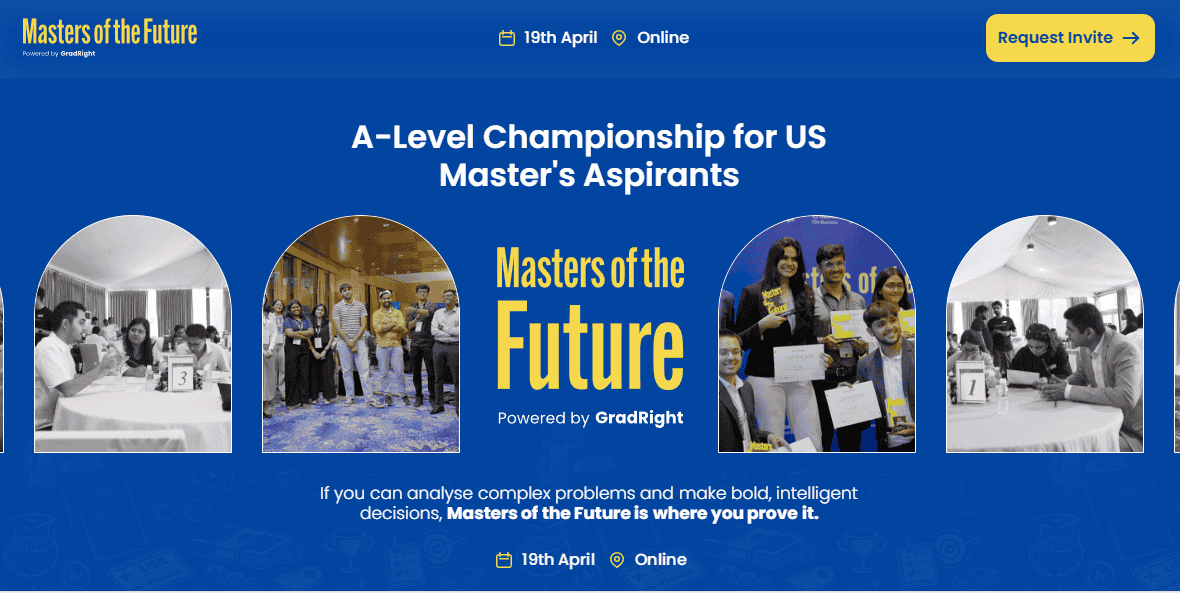
It’s built specifically for final-year students and working professionals in CS, engineering, finance, analytics, and business who are planning a master’s in the US.
Here’s what makes it different from everything else on this list.
- The admissions teams from these universities are directly involved. They’re watching participants solve real business problems and evaluating how they think.
“After the inaugural edition, Prof. Timothy Solberg from WashU’s Olin Business School said the quality of work from the finalist teams showed students were well prepared for Olin’s most selective master’s programs”.
That’s not a brochure quote. That’s a professor who watched students work for two days and was impressed.
- The outcomes are tangible.
- A ₹5 Crore scholarship pool from partner universities.
- Prizes worth over ₹4 lakhs.
- Sponsored one-way flight tickets to the US for the winning team.
- Direct admission consideration.
- Priority education loans up to ₹1 Crore.
- Mentorship from people like Sarbvir Singh (CEO, PolicyBazaar), Kapil Bharati (Co-founder, Delhivery), and Bipin Preet Singh (CEO, MobiKwik).
- It has two separate tracks: one for students, one for working professionals, because a final-year student and someone with five years of experience shouldn’t be evaluated the same way.
- And it’s free to enter. The finale is online (April 19, 2026), so your location doesn’t limit your shot.
If your goal is specifically a US master’s and you want to be seen by the universities you’re applying to, MOTF is the most directly useful competition I know of.
[Register for MOTF 2026] to request an invite.
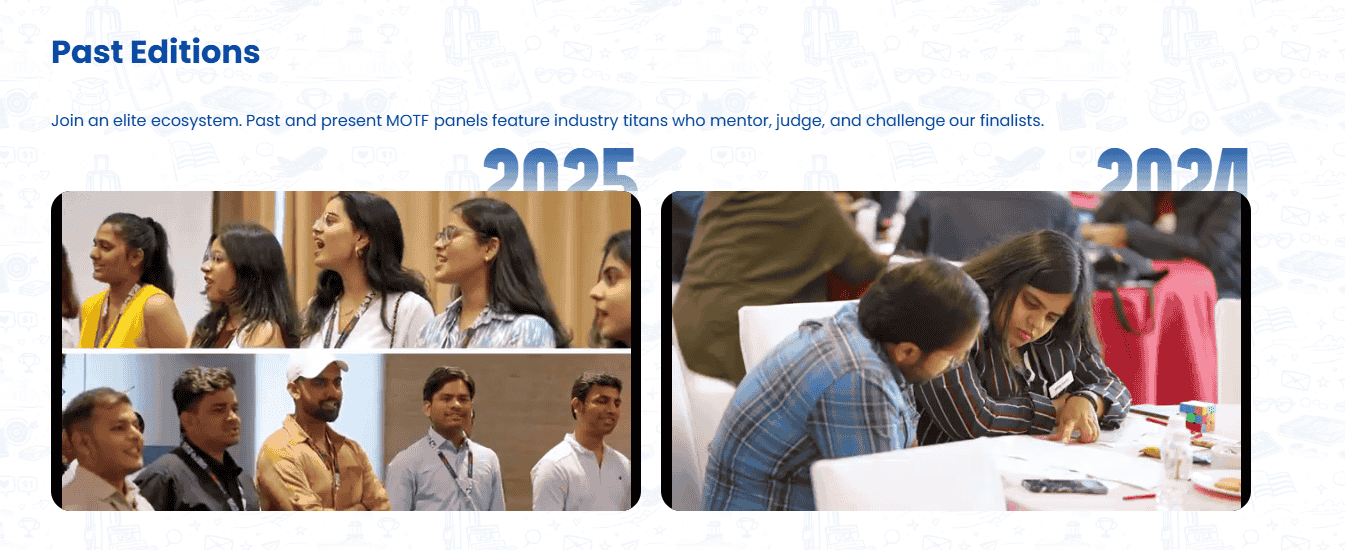
And to see what the experience actually looks like, watch the MOTF 2025 highlights.
So How Do You Choose?
Don’t do ten competitions. That’s a mistake I see students make all the time. Pick one or two that actually align with what you’re trying to achieve, and perform well there instead of stretching yourself thin.
If you’re a CS student applying for an MS in computer science, consider ICPC for the technical credibility and MOTF for the admissions and scholarship angle.
If you’re in finance, analytics, or business, MOTF is the most relevant thing out there. Hult Prize is worth it if social entrepreneurship genuinely interests you, but don’t do it just for the resume line.
If you’re a working professional, most competitions are designed for college students. MOTF’s professional track is one of the few options specifically built for people in your situation.
And here’s the most important thing: a competition only helps your application if you can tell a real story about it. Not “I participated.” But “here’s what I built, here’s what I learned, here’s how it changed my thinking.”
Admissions teams read hundreds of applications. They remember stories, not credential lists.

And if you’re figuring out the bigger picture like which universities, which loans, what scholarships, download the GradRight app from Google Play Store or Apple App Store.









 Australia
  Canada
  France
  Germany
  India
India  Ireland
  UAE
UAE  United Kingdom
  United States