



A few months ago, I was talking to a student from Nagpur. Final year, computer science, solid grades. She wanted to do an MS in the US.
I asked her a simple question: “Why this university?”
She said, “My senior went there.”
That’s it. That was the reason behind a ₹30 lakh decision. And honestly, I wasn’t surprised.
I’ve been in higher education for over 18 years now and know this conversation too well.
It’s always someone’s cousin, someone’s consultant, someone’s WhatsApp group. Almost never the student’s own informed choice.
And I don’t blame them. The whole process is a black box.
Sure, you can Google anything right across rankings, course lists, tuition fees. Information isn’t the problem, but there’s no way to sit across from an alumni of the college you’re considering, or have a real conversation with a faculty member, or get honest advice from a CEO in the industry you want to build a career in. That human layer is completely missing. This is the problem we hope Masters of the Future (MOTF) solves, in a way that’s more personal than anything currently available to an Indian student.
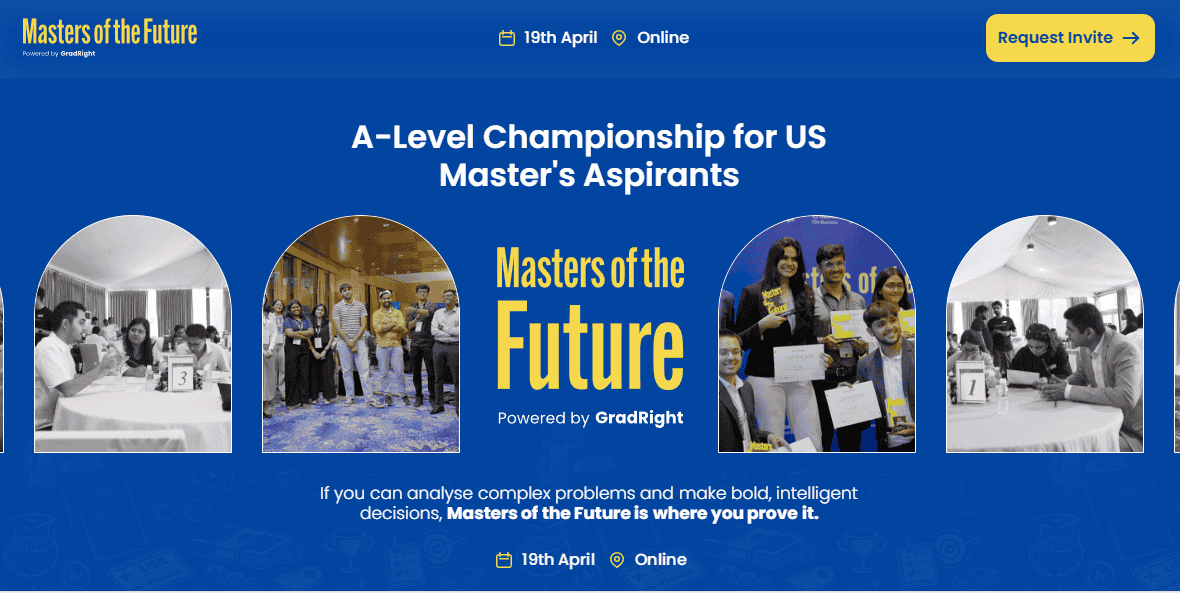
I’ve written this to explain why I believe Masters of the Future is a POC of how an Indian student should go about searching for their higher-ed uni.
So what is Masters of the Future (MOTF), actually?
MOTF is a national competition organized by GradRight in partnership with US universities like WashU Olin, Rutgers Business School, Lehigh, and Tulane. It is for final-year students and working professionals who are serious about a master’s abroad in the USA. It’s a platform where you solve real business problems in front of the people who actually decide admissions and scholarships, and they evaluate you on how you think and perform, not your GRE score or your SOP.
And what you’re competing for is substantial.
- Prizes worth over ₹4 lakhs.
- A scholarship pool of ₹5 Crore from partner universities, which is the largest in India for something like this.
- Sponsored one-way flight tickets to the US for the winning team. Direct admission consideration from universities like Washington University in St. Louis, Rutgers Business School, Lehigh, Tulane, University of San Diego, and University of South Dakota.
- Mentorship from people like Sarbvir Singh of PolicyBazaar, Kapil Bharati of Delhivery, and Bipin Preet Singh of MobiKwik.
- Priority education loans up to ₹1 Crore.
But honestly, even beyond the prizes, even the process itself is valuable. At every step, you’re being tested on how you think, not what you’ve memorized. And for the first time, admissions teams from these universities are watching you in action, not just reading your application.
If this sounds like something worth exploring, you can request an invite at plan.gradright.com/motf.
How does Masters of the Future (MOTF) work?
There are two tracks. If you’re a final-year student in CS, engineering, finance, analytics, or business (and you’re planning for a US master’s) you enter the student track.
If you’re a working professional with a few years of experience in similar fields and you’re thinking about going back for a master’s, there’s a separate track designed for your situation.
For students, you start by submitting a research or capstone project, which can be something you’ve already been working on. If it’s strong, you go through an interview. Do well there, and you present at zonal level. The top 30 from across India make it to the finale.
For professionals, you showcase a real-world project with measurable impact, go through a leadership and readiness interview, and the best performers advance to the finale.
The finale itself is an online event; this year (2026) it’s on April 19th. The top 30 candidates spend two days solving real challenges together, presenting their ideas to global experts, and getting evaluated by people who actually matter for their careers.
What happened in earlier editions of MOTF?
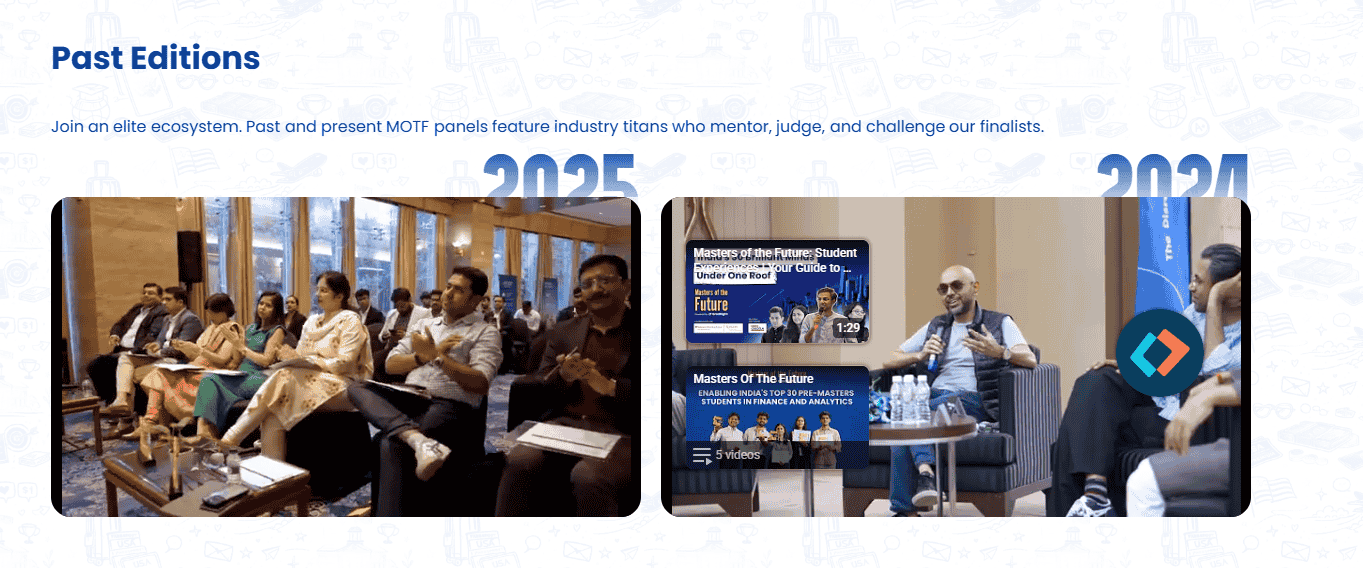
We’ve run two editions of MOTF. The second one, in 2025, was a 48-hour brain retreat with 30 finalists, where they:
- solved real business challenges under pressure
- sat with CXOs for one-on-one mentorship
- some walked away with scholarships up to $30,000
- all of them walked away with something harder to measure: clarity about what they wanted, confidence that they could get there, and a peer group that’s still in touch.
Partner universities (Rutgers, WashU Olin, Brandeis, Shiley-Marcos, University of South Dakota) were actively involved. Their admissions teams saw these students think and collaborate in real time.
Prof. Timothy Solberg from Washington University’s Olin Business School, who was there, said that the standard of work from the finalist teams showed that students were well prepared for Olin’s most selective master’s programs. That’s something no SOP can capture.
“I am thrilled to have witnessed the passion and dedication of students at ‘Masters of the Future’. Their eagerness to explore academic opportunities aligns perfectly with our university’s ethos of excellence and innovation. The high standard of financial analysis done by the three case study finalist teams show students are well prepared to benefit from Olin Business School’s highly selective Masters programs.”
- Prof. Timothy Solberg, Director of Corporate Finance and Investments Platform, Washington University (Olin Business School)
Watch highlights from MOTF 2025.
Watching those 30 students over those two days was one of the most rewarding experiences I’ve had as a founder. Not because of the event itself, but because of what it proved: when you give talented people a fair platform, they rise.
What is new in MOTF 2026?
MOTF 2026 has changed based on what we learned.
Two separate tracks, because a final-year student and a working professional with five years of experience shouldn’t be evaluated the same way.
A bigger university partner list.
An online format so that your location doesn’t limit your shot.
The philosophy hasn’t changed, though. Higher education shouldn’t be a black box. You should get a platform to test your suitability before committing your family’s savings. And universities should get to see who you really are, not just what fits on a form.
How to be a part of MOTF 2026?
I think about that student from Nagpur a lot. She had everything, the grades, the drive, the curiosity. What she didn’t have was a way to prove it to anyone who mattered.
If you’re in that position, MOTF is worth your time. It’s free to apply. The first round takes less time than filling out a university application. And the upside is significant.
Request an invite at plan.gradright.com/motf.
And to find all the information you need about finding the right university and the right education loan, download the GradRight app from Google Play Store or Apple App Store.









 Australia
  Canada
  France
  Germany
  India
India  Ireland
  UAE
UAE  United Kingdom
  United States