




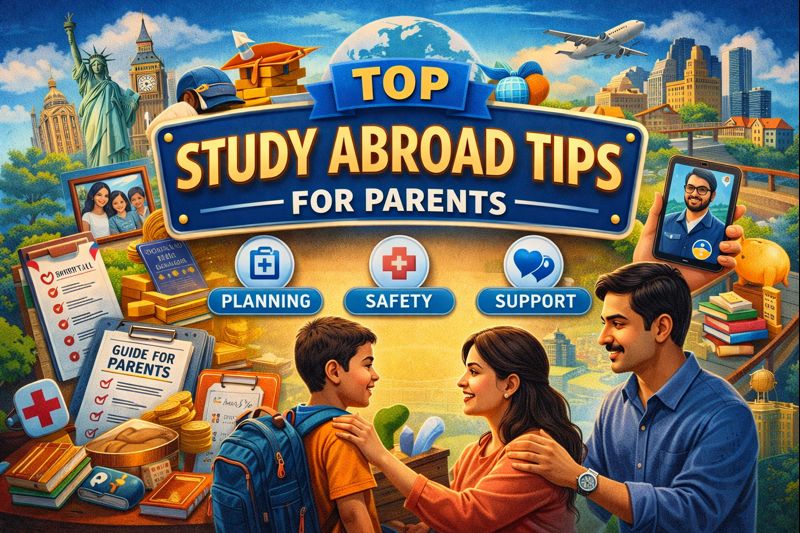
Quick Answer
Supporting a child through study abroad works best when parents prepare practically (visas, healthcare, budgeting, a document checklist) and emotionally (accepting reduced daily contact, encouraging independence, avoiding over-management). Health insurance requirements vary by country, university, and visa type, so confirm what’s specifically required for your child’s destination rather than assuming a universal rule. US F-1 students specifically must generally return within 5 months of leaving the country to keep their student status intact, with an exception for approved study-abroad programs.
When a child decides to study abroad, the decision rarely belongs to the student alone. It becomes a family decision. Parents worry about safety, finances, health, emotional wellbeing, and whether their child is truly ready to live independently in another country.
For many families, especially in India, overseas education is exciting but deeply emotional. Parents want to support their child’s dreams while also protecting them from risks they may not yet see.
This guide brings together practical, realistic tips for parents of students studying abroad, based on real concerns families face before and after their child leaves home. It’s designed to complement GradRight’s broader Parent’s Guide to Study Abroad, covering planning, emotional readiness, safety, and long-term family wellbeing.
1. Preparation Matters More Than Destination
Before choosing a country or university, it’s worth focusing on preparation. Many of the challenges students face abroad don’t come from academics, but from daily life responsibilities they haven’t had to manage before.
What parents should help with early:
– Learn about visa rules and work limits together
– Understand the healthcare system in the destination country
– Review accommodation options carefully
– Discuss daily budgeting and living costs
– Understand emergency protocols
Parents who prepare well tend to reduce anxiety for both themselves and their child – this step is easy to overlook, but it sets the foundation for everything else.
Also Read: How Studying Abroad Can Lead to Financial Independence
2. Understand How Different Life Abroad Will Actually Be
Sending a child overseas is not just about tuition fees and flights. It helps to understand upfront how different daily life will genuinely be for them.
A few realities worth knowing in advance:
– Your child will be managing most day-to-day decisions alone
– Cultural differences may affect their confidence initially
– Homesickness is common and a normal part of the adjustment
– Support systems abroad take time to build
– Independence comes with some mistakes along the way
Knowing this in advance helps families avoid unrealistic expectations and unnecessary panic during the early months.
3. Build a Clear Checklist Together
A structured checklist keeps families organized and reduces last-minute stress. A good checklist covers more than just documents:
– Passport, visa, and copies of all documents
Also Read: Student Health Insurance: What You Need to Know
– Health insurance and vaccination records
– Emergency contacts in both countries
– Accommodation details and local address
– University contact numbers
– Banking and forex arrangements
– International phone plan
– Copies of academic records
Review this checklist together as a family, so everyone knows what’s already covered and what still needs attention.
Also Read: Essential Things International Students Must Know About Forex
4. Emotional Readiness Matters as Much as Practical Prep
Parents often focus heavily on preparing their child but rarely prepare themselves. Emotional readiness is just as important for the rest of the family.
This means accepting that communication will change. Your child won’t call every day. They’ll become more private. They’ll make decisions without consulting you first – and that’s a normal, healthy part of the process, not a sign that something’s wrong.
A few ways parents can prepare emotionally:
– Accept that independence is part of growth
– Avoid micromanaging daily routines
– Encourage problem-solving instead of rescuing
– Trust the preparation you’ve already done together
Learning to let go gradually is genuinely one of the harder parts of overseas education for families.
5. Support Without Adding Pressure
It’s easy to believe that constant advice equals support. In reality, too much guidance can overwhelm a student who’s already adjusting to a lot at once.
What actually tends to help:
– Listening without immediate judgement
– Offering reassurance instead of solutions
– Encouraging social connections
– Reminding them that adjustment takes time
– Being open to mental health conversations, not just academic ones
Sometimes the most powerful support is simply saying, “You are doing fine.”
6. Safety and Wellbeing Basics Worth Discussing
Safety is one of the biggest concerns for parents. Most study destinations are genuinely safe, but a few basic practices are worth discussing together before departure:
– Understanding local laws and emergency numbers
– Avoiding unsafe areas at night
– Registering with the local embassy or consulate, where recommended for your destination
– Keeping emergency funds accessible
– Knowing how to access medical help quickly
7. Coping as a Parent While Your Child Is Away
One of the more common questions parents have is simply: how do you cope with a child studying abroad? The honest answer is that it comes down to balance.
Healthy ways to cope:
– Maintain a regular but flexible communication schedule
– Stay engaged with your own work, hobbies, and social life
– Avoid constant tracking or monitoring
– Celebrate your child’s milestones, even from a distance
– Build trust instead of leading with fear
Parents who adapt emotionally often find their relationship with their child grows stronger over time, not weaker.
8. Understand the F-1 Five-Month Rule (US-Specific)
If your child is studying in the USA on an F-1 visa, one specific rule is worth understanding clearly: under US federal regulation (8 CFR 214.2(f)(4)), if an F-1 student leaves the United States for more than 5 months and isn’t able to remain enrolled at their SEVP-certified school during that time, they won’t be able to maintain their student status. To resume studies in the US, they’d need to seek readmission in initial status, including a new Form I-20 and a new SEVIS fee payment – a genuinely disruptive process.
There’s an important exception: this rule generally doesn’t apply to an F-1 student pursuing a full course of study while physically engaged, in-person, in an authorized study-abroad program that remains part of their US degree – as long as they stay enrolled and it’s properly reported to their university’s international office. Some universities also extend this to approved co-op or research placements abroad, though exact eligible activities can vary by institution’s interpretation, so confirm directly with your child’s Designated School Official (DSO) rather than assuming. This rule is specific to US F-1 students – other countries have their own separate residency and visa-continuity requirements, so don’t assume it applies the same way elsewhere.
What parents should do:
– If your child is on a US F-1 visa, confirm this rule with their university’s international student office before any extended trip home
– Encourage them to track travel dates carefully, especially around long breaks or family emergencies
– For other countries, ask about that specific country’s own visa-continuity or residency rules, since they vary meaningfully
Also Read: Understanding Post-Study Work Options in the USA
9. Financial Transparency Reduces Family Tension
Financial stress is a major source of tension for both parents and students – openness about money early on genuinely helps.
A few practices worth adopting:
– Create a realistic monthly budget together
– Discuss spending habits openly, without judgement
– Set aside emergency funds specifically
– Avoid transferring money impulsively in response to every request
– Use the process as an opportunity to build your child’s financial responsibility
Strong financial communication builds confidence on both sides. If financing the degree itself is still a work in progress, GradRight’s loan comparison platform connects you with 18 lending partners competing to offer better rates, so the family isn’t navigating this alone.
10. Supporting Parents Back Home, From Abroad
A less-discussed worry: students often feel guilty about being far away when parents might need support themselves.
A few ways students can stay meaningfully connected:
– Regular check-ins, not just when something’s wrong
– Helping parents get comfortable with digital tools for staying in touch
– Coordinating with relatives locally, where possible
– Staying emotionally present even when physically distant
Parents can help by reassuring their child that support systems exist at home, and that distance doesn’t mean neglect – this reassurance genuinely reduces guilt-driven stress for the student.
11. Supporting Younger Students Specifically
For guardians supporting younger students – undergraduate freshmen, for instance – involvement is often naturally higher during the first year.
What guardians of younger students should focus on:
– Monitoring adjustment without hovering
– Encouraging independence gradually, not all at once
– Staying informed about academic progress through appropriate channels
– Being available without controlling every decision
This balance helps younger students grow confidently while still knowing support is genuinely available when needed.
Final Thoughts
Studying abroad transforms not just students, but families. It teaches independence, trust, patience, and emotional growth on both sides.
The most useful approach for parents combines preparation, communication, emotional balance, and trust. When families treat overseas education as a shared journey rather than a distant separation, the experience tends to become healthier and more meaningful for everyone involved.
Related Articles
The Parent’s Guide to Study Abroad: Everything You Need to Know
Student Health Insurance: What You Need to Know
Essential Things International Students Must Know About Forex
Understanding Post-Study Work Options in the USA
How Studying Abroad Can Lead to Financial Independence
Plan the Practical Side Together
GradRight’s AI-powered platform can help your family shortlist universities and compare education loan offers from 18 lending partners in one place, so the financial and academic planning happen together, not as separate stressors. Start your free profile at gradright.com/selection/.







 Australia
  Canada
  France
  Germany
  India
India  Ireland
  UAE
UAE  United Kingdom
  United States