
You know you need your GRE results for admission to your dream college. But how much do you need to score? What is the GRE total score? What is the GRE max score? And most importantly, what is a good GRE score?
Find answers to all these questions in our detailed blog on GRE results analysis and interpretation below.
What Is GRE?
The Graduate Record Examination (GRE) is a standardised test used to measure an individual’s verbal and quantitative aptitude and analytical capabilities.
The GRE results are used by thousands of graduate schools across the globe as admission criteria. For foreign education aspirants, GRE results are an important factor in determining their admission eligibility. GRE results also determine whether applicants are eligible for securing scholarships and finance for foreign education.
GRE Scoring 2026 (Section-wise)
Let’s take a look at the GRE total score, GRE score range, GRE max score, and GRE score percentiles.
GRE Score Range and GRE Max Score
The overall GRE score is calculated by adding the Verbal and Quantitative section scores. The Analytical Writing score is reported separately.
|
Section |
GRE Max Score |
GRE Score Range |
Increments |
|
Verbal Reasoning |
170 |
130-170 |
1-point increments |
|
Quantitative Reasoning |
170 |
130-170 |
1-point increments |
|
Analytical Writing |
6 |
0-6 |
0.5-point increments |
While these are the GRE max scores, it is extremely hard to achieve them:
- Less than 1% of students achieve a perfect score in the Verbal section.
- Less than 3% of students achieve a perfect score in the Quantitative section.
GRE Score Percentiles
Your GRE results include the scaled score along with your GRE score percentiles. GRE score percentiles show how you did compared to other people who took the test. If you’re in the 80th percentile, you scored better than 80% of test-takers.
Note: ETS updates percentile data annually based on the past 3 years of test-taker data. The percentiles below are from the most recent ETS data. Verify current percentiles at ets.org/gre/scores/interpret.
|
Verbal Score |
V %ile |
Quant Score |
Q %ile |
AW Score |
AW %ile |
|
170 |
99th |
170 |
96th |
6 |
99th |
|
169 |
99th |
169 |
93rd |
5.5 |
97th |
|
168 |
98th |
168 |
90th |
5 |
91st |
|
167 |
98th |
167 |
87th |
4.5 |
79th |
|
166 |
97th |
166 |
84th |
4 |
54th |
|
165 |
95th |
165 |
81st |
3.5 |
37th |
|
164 |
94th |
164 |
78th |
3 |
13th |
|
163 |
92nd |
163 |
76th |
2.5 |
6th |
|
162 |
90th |
162 |
73rd |
2 |
2nd |
|
161 |
87th |
161 |
70th |
1.5 |
1st |
|
160 |
85th |
160 |
67th |
– |
– |
|
159 |
81st |
159 |
64th |
– |
– |
|
158 |
78th |
158 |
61st |
– |
– |
|
157 |
74th |
157 |
57th |
– |
– |
|
156 |
71st |
156 |
54th |
– |
– |
|
155 |
67th |
– |
– |
– |
– |
This percentile table will help you understand what universities you can apply to. For guidance on selecting the right university, use GradRight.
Find universities that match your GRE score – AI-powered search across 40,000+ programs. Explore on GradRight
Average GRE Scores
The answer to ‘what is a good GRE score out of 340’ depends on the university and program you’re applying to. To get a general understanding, here are the average GRE scores:
|
Section |
Average GRE Score (2025-26 data) |
|
Verbal Reasoning |
151 out of 170 |
|
Quantitative Reasoning |
155 out of 170 |
|
Analytical Writing |
3.6 out of 6 |
What is a ‘good’ GRE score? It depends entirely on your target program. MIT STEM programs may expect Quant 165+. Liberal arts programs at mid-tier universities may accept Verbal 155+. Always check official university admissions pages for their specific GRE score requirements.
Also Read: GRE Exam 2026: Complete Guide – Format, Fees and Syllabus
Understanding How GRE Results Are Calculated
Verbal Reasoning and Quantitative Reasoning
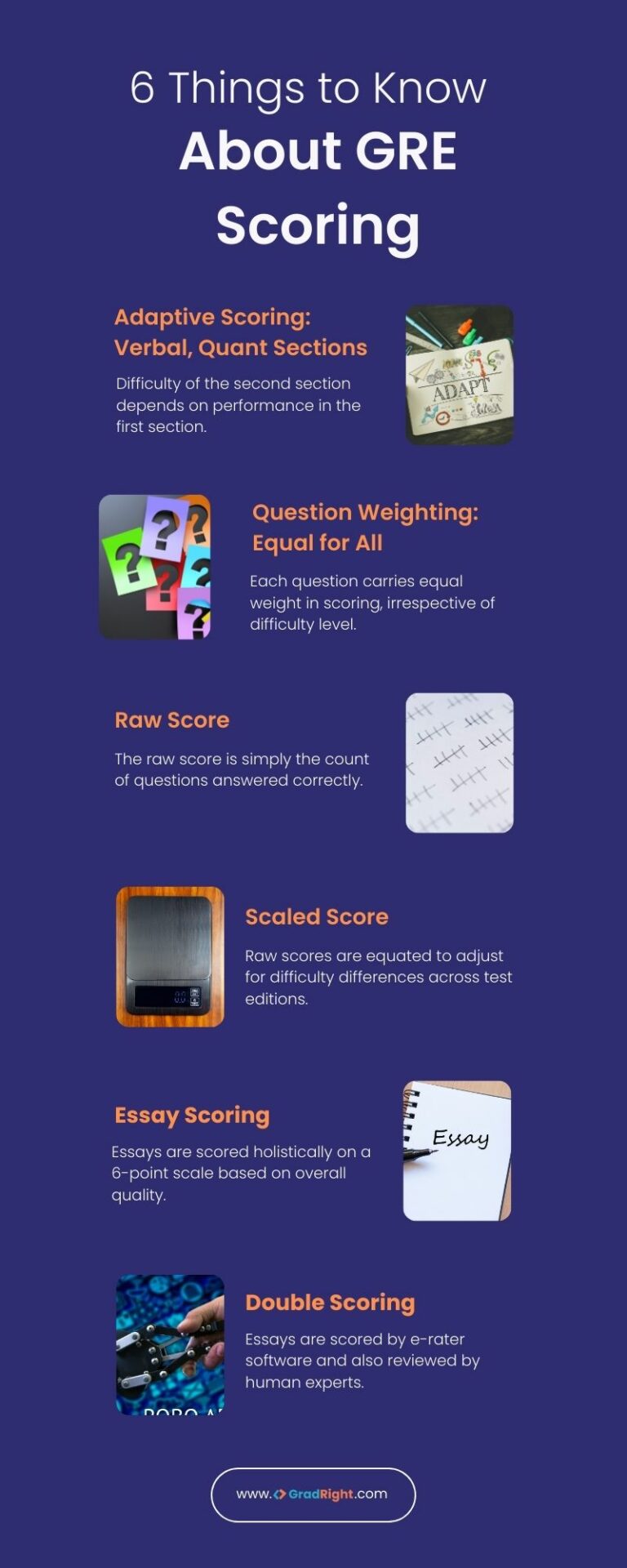
The verbal reasoning and quantitative reasoning tests are section-adaptive. The difficulty of the second section is based on your performance in the first section.
Scoring Process:
- Count correct answers to get the raw score.
- Calculate a scaled score by ‘Equating’ the raw score – adjusting for differences in difficulty among different test editions. This gives a fair score regardless of which second section you received or your test date.
Analytical Writing
Essays are scored on a 6-point holistic scale by a combination of the e-rater® scoring engine (computer program) and trained human analysts.
Scoring Process:
- A computerised score is calculated by e-rater® based on writing features.
- Trained analysts and experts review all essay responses.
- If human and e-rater scores closely align, the average becomes the final score. If there is significant discrepancy, a second human rater evaluates the essay.
Also Read: GRE Exam Pattern 2026: Revised Format Explained
Also Read: GMAT vs GRE 2026: Key Differences and Which to Choose









 Australia
  Canada
  France
  Germany
  India
India  Ireland
  UAE
UAE  United Kingdom
  United States