





Your MBA SOP is the one document in your application where you get to speak directly to the admissions committee. Your GMAT score, your GPA, your transcripts – the committee sees those before they even open your essay. The SOP is where they decide if they want you in their classroom.
An MBA SOP is different from an MS SOP. You are not explaining research interests or technical skills. You are making a business case for yourself – why an MBA, why now, why this school, and where you are going. This guide walks you through exactly how to do that.
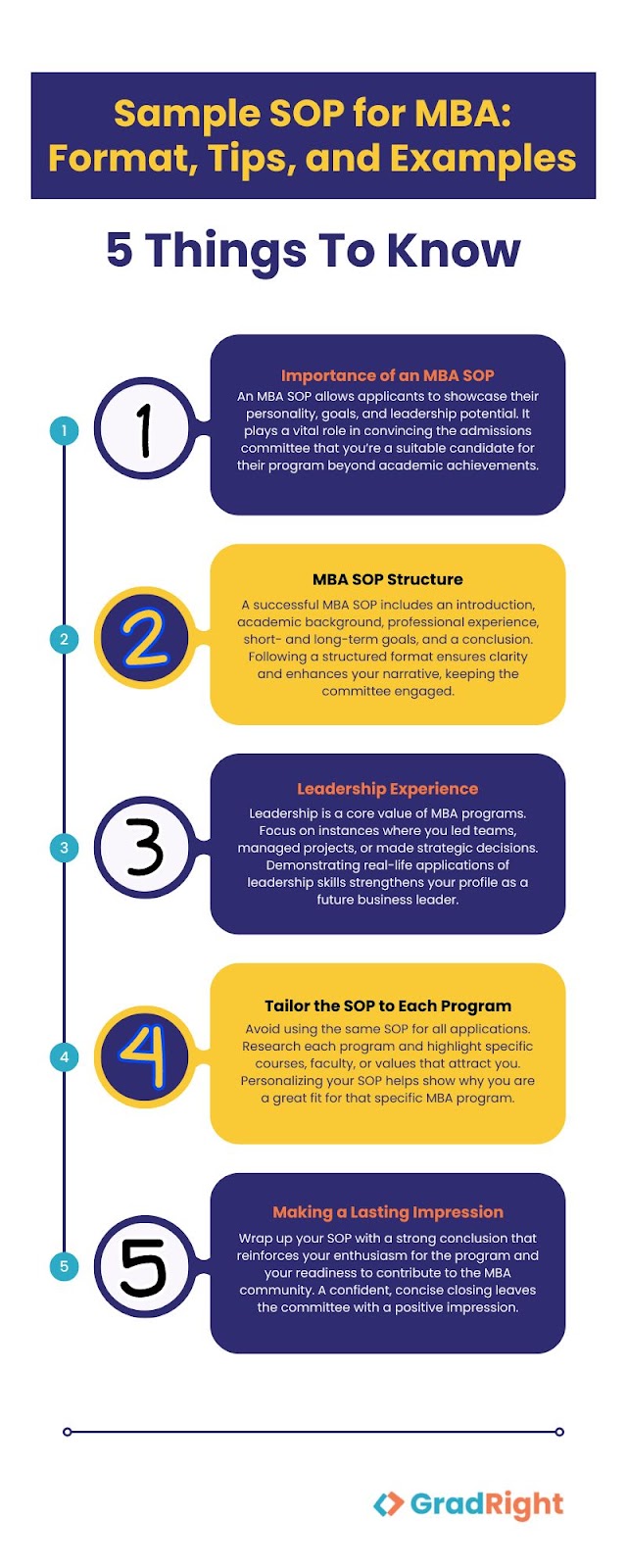
SOP for MBA – Quick Reference
|
Question |
Answer |
|
What is an MBA SOP? |
A 500-1,000 word essay explaining your professional background, career goals, leadership experience, and why you need an MBA from this specific school. |
|
How long should it be? |
500-1,000 words for most schools. Some top programs like HBS and Wharton have specific essay prompts with their own word limits. |
|
Biggest difference from MS SOP? |
MBA SOP is work-experience driven. Leadership, business impact, and “why MBA now” are central. Research interests are not. |
|
What do top schools look for? |
Leadership potential, clear career goals, genuine “why this program” reasons, and a compelling personal narrative. |
|
Most common mistake? |
Writing a resume in paragraph form. Your SOP should tell a story your resume cannot. |
What is an SOP for MBA?
An SOP for MBA is a personal essay you submit as part of your business school application. It answers the core question that your GMAT score, GPA, and resume cannot: Why do you want an MBA, why now, and why this program?
According to GMAC, more than 90% of top MBA programs consider the SOP a crucial part of the application. With acceptance rates at top business schools ranging from 10-20%, a strong SOP is often what separates an offer letter from a rejection.
For Indian students, this matters even more. Indian applicants make up one of the largest pools for US and UK MBA programs. Admissions committees see hundreds of profiles from Indian IT professionals, consultants, and engineers with similar backgrounds. Your SOP is where you stand out.
Also Read: MBA Abroad for Indian Students – Top Programs, Costs and ROI
MBA SOP vs MS SOP – Key Differences
|
Factor |
SOP for MBA |
|
|
Primary focus |
Leadership, business impact, career goals |
Academic background, research, technical skills |
|
Work experience |
Central – most applicants have 2-5+ years |
Optional – many apply as fresh graduates |
|
Key question to answer |
“Why MBA? Why now? Why this school?” |
“Why this field? What do I want to research?” |
|
Length |
500-1,000 words |
800-1,200 words |
|
Tone |
Professional, confident, story-driven |
Academic, analytical, goal-driven |
|
School customization |
Critical – every school needs a unique version |
Important but slightly more formulaic |
SOP Format for MBA – Section by Section
There is no universal MBA SOP template. But the most effective SOPs follow a clear structure that flows logically from your past to your future:
|
Section |
What to Write |
Word Count |
|
1. Introduction / Hook |
Open with a specific professional moment, challenge, or turning point. Not “I have always been passionate about business.” A real situation that shows why an MBA became necessary. |
80-120 words |
|
2. Professional Background |
Your work experience, key achievements, and the impact you have created. Use numbers – revenue managed, team size led, cost reductions achieved. Focus on leadership moments. |
150-200 words |
|
3. Why MBA Now |
The gap between where you are and where you want to go. What skills, network, or knowledge does an MBA provide that you cannot get elsewhere? Be specific. |
100-150 words |
|
4. Career Goals |
Short-term goal (role and industry immediately post-MBA) and long-term goal (5-10 years). Be specific. “I want to work in consulting” is weak. “I want to join McKinsey’s Operations practice and eventually lead supply chain transformation projects for Indian FMCG companies” is strong. |
100-150 words |
|
5. Why This School |
The most critical section for differentiation. Name specific courses, professors, clubs, case competitions, alumni networks, or industry connections unique to this school. This section must be different for every application. |
100-150 words |
|
6. Conclusion |
Brief, confident close. Restate your fit for the program and your enthusiasm. No new information. |
50-80 words |
Total target: 500-1,000 words. Always check the specific school’s website – top programs like HBS, Wharton, and Stanford GSB use their own essay prompts instead of a generic SOP format.
Also Read: Top MBA Colleges in USA for Indian Students – Rankings and Fees
How to Write an SOP for MBA – Step by Step
- Start with your professional story. List your top 5 career achievements – moments where you led, decided, or delivered measurable impact. These become the raw material for your SOP.
- Answer ‘Why MBA now?’ honestly. What specific skill, credential, or network do you need that only an MBA provides? The answer to this question is the spine of your SOP.
- Define your goals precisely. Short-term: specific role, industry, geography. Long-term: what impact do you want to make in 10 years? Vague goals signal unclear thinking.
- Open with a hook, not a bio. Your first sentence should make the reader want to continue. Start with a real professional challenge, a decision you had to make, or a moment of clarity – not your name and job title.
- Research each school deeply before writing that section. Visit the school’s website, read faculty profiles, look up current student clubs, and talk to alumni if possible. Generic ‘why this school’ sections are immediately obvious.
- Write the first draft without editing. Get everything on paper first. You will cut and shape later – trying to write and edit at the same time kills momentum.
- Cut your resume from your SOP. Everything in your SOP should add new information or context. If a committee member can find the same thing on your resume, cut it.
- Get feedback from a manager or mentor who knows your work. They will catch inconsistencies, missing context, and places where your narrative is unclear.
Writing your MBA SOP? GradSOP helps you build a personalized draft tailored to your profile, program, and goals – in minutes. Try GradSOP Free
Sample SOP for MBA – USA Business School
Here is a sample MBA SOP to help you understand structure, tone, and narrative. Use this as a reference – do not copy it. Your SOP must reflect your specific experiences and goals.
[SAMPLE SOP – MBA, USA Business School]
When the logistics startup I was managing operations for missed its Q3 delivery targets by 23%, I was the one who had to explain it to the board. We had built a strong product and grown our client base to 40 companies across South India. But we had no system for managing the complexity that came with that scale. That meeting taught me what no course had – that operational excellence without strategic thinking eventually breaks down. It also showed me exactly where I needed to grow.
I am a Mechanical Engineering graduate from BITS Pilani with four years of experience in supply chain and operations, currently working as Operations Manager at [Company Name], a B2B logistics firm headquartered in Bangalore. In this role, I manage a team of 18 and oversee end-to-end fulfilment for 60+ enterprise clients. Over the past two years, I have reduced average dispatch time by 31% and helped the company achieve its first profitable quarter by restructuring our vendor relationships.
What I lack – and what an MBA will give me – is the strategic and financial framework to make decisions at the business level, not just the operations level. I understand supply chains. I need to understand how supply chain decisions affect P&L, how to raise capital to fund expansion, and how to build and lead a management team. I am also aware that the network I build in business school will shape the opportunities available to me for the next 20 years.
My short-term goal is to join a management consulting firm – specifically McKinsey, BCG, or Bain – and work on operations and supply chain transformation projects in India and Southeast Asia. Within 10 years, I plan to return to the startup ecosystem and build a technology-enabled logistics company that can compete at the enterprise level across South and Southeast Asia.
I am applying to [School Name] because of Professor [Name]’s research on emerging market supply chain resilience, which closely aligns with the problems I have been trying to solve at [Company Name]. The MBA program’s focus on entrepreneurship alongside its strong consulting placement track record makes it uniquely suited to my goals. The South Asia Business Club and the Operations Management elective track are two specific reasons this program stood out when I was researching schools.
I am ready for this next step. My professional experience has given me a clear view of what I can do and what I need to build. [School Name]’s MBA program is where I want to build it.
[End of sample – approx. 450 words. Expand each section to reach 700-900 words for your actual application.]
MBA SOP Dos and Don’ts
|
Do’s |
Don’ts |
|
Open with a specific professional moment |
Start with ‘I have always been passionate about business’ |
|
Use real numbers and measurable impact |
List responsibilities without showing results |
|
Make “Why this school” unique per application |
Use the same paragraph for every school |
|
State specific short and long-term goals |
Say “I want to work in consulting or finance” |
|
Show leadership – decisions made, teams led |
Focus only on technical skills |
|
Keep sentences short and direct |
Write long paragraphs that bury your best points |
|
Connect your past, MBA, and future goals |
Let each section feel disconnected from the others |
|
Answer “Why MBA now?” directly |
Leave the committee guessing why you chose this timing |
Also Read: SOP for USA – Samples, Format and Examples
MBA SOP Tips by School Type
Different schools look for different things. Here is what to emphasize based on where you are applying:
|
School Type |
What They Look For |
Customize Your SOP By |
|
Top US Programs (HBS, Wharton, Stanford GSB) |
Leadership at scale, self-awareness, impact on others, “why MBA” clarity |
These schools use their own essay prompts – not a generic SOP. Follow each school’s specific questions. |
|
Strong US Programs (Kellogg, Booth, Tuck, Ross) |
Team leadership, collaborative mindset, clear career goals, fit with school culture |
Research each school’s culture and values. Kellogg = teamwork. Booth = analytical rigor. |
|
UK Programs (LBS, Oxford Said, Cambridge Judge) |
Global mindset, professional maturity, concise writing, academic rigor |
Keep it tighter – 500-700 words. UK schools value brevity. |
|
European Programs (INSEAD, IE, ESADE) |
International experience, cultural adaptability, multilingual skills, global career vision |
Emphasize your international exposure and global career plans. |
|
Canadian Programs (Rotman, Ivey, Desautels) |
Community involvement, leadership, why Canada, Canadian industry connections |
Address why Canada specifically if you are applying from India. |
Also Read: MBA in USA for Indian Students – Costs, Top Schools and ROI
MBA SOP Length, Font and Formatting
|
Element |
Standard Guideline |
|
Word count |
500-1,000 words (unless school specifies otherwise) |
|
Font |
Times New Roman 12pt or Arial 11pt |
|
Line spacing |
Single or 1.5 – check school guidelines |
|
Margins |
1 inch on all sides |
|
File format |
PDF – prevents formatting changes |
|
Paragraphs |
5-6 focused paragraphs – no bullet points in the SOP itself |
|
Headers |
Generally avoid section headers – let the writing flow naturally |
Found the right MBA program? Compare education loans from 18+ lenders and plan your financing before you apply. Compare Education Loans on GradRight
Related Guides and Resources
SOP for MS – How to Write, Format and Sample
SOP for USA – Samples, Format and Examples
SOP Samples – Course and Country-wise Guide
Winning SOPs that Got Indian Students into Harvard
GradSOP – AI-Powered SOP Writing Tool
How to Write a Professional LOR
MBA Abroad for Indian Students
Top MBA Colleges in USA for Indian Students





 Australia
  Canada
  France
  Germany
  India
India  Ireland
  UAE
UAE  United Kingdom
  United States